Blog

Key takeaways:
Ask ten founders whether outsourcing software development worked, and you will get ten answers that sound like they are describing different industries. One shipped a funded platform for a fraction of what a hiring round would have cost. Another spent eight months and six figures on a codebase nobody could maintain.
Both are telling the truth. The variable that separates them is almost never the country the developers sat in, and almost always something duller: how well the work was defined, and whether anyone on the buying side could tell good code from a convincing demo.
This guide takes the question seriously in both directions. We will name the real benefits with numbers attached, the failure modes that get left out of the sales deck, what the work actually costs, and the specific conditions under which outsourcing software development beats hiring. Then we will give you a straight answer.
"Outsourcing" gets used as though it describes one thing. It describes at least four, and they carry different risks, different price tags, and different amounts of work for you.
The distinction that matters most is not geography. It is who owns the outcome. In some models you are buying hours and you own the plan. In others you are buying a delivered product and the provider owns the plan. Confusing the two is the single most common reason an engagement goes sideways.
| Model | What you buy | Who owns the plan | Best when |
|---|---|---|---|
| Staff augmentation | Individual engineers who join your team | You do | You have technical leadership and need capacity |
| Dedicated team | A standing squad, usually with a lead | Shared | Ongoing roadmap, months to years of work |
| Project-based | A defined scope for a fixed price or cap | The provider | Scope is genuinely knowable up front |
| Managed product | Strategy, design and build to an outcome | The provider | You need the thinking, not just the hands |
Custom software development outsourcing spans all four. Geography then layers on top: onshore (same country), nearshore (nearby time zones), and offshore (distant time zones). Each affects rate and overlap hours, but none of them determines quality on its own.
Ordered by who owns the plan, the four models sit on a single line.
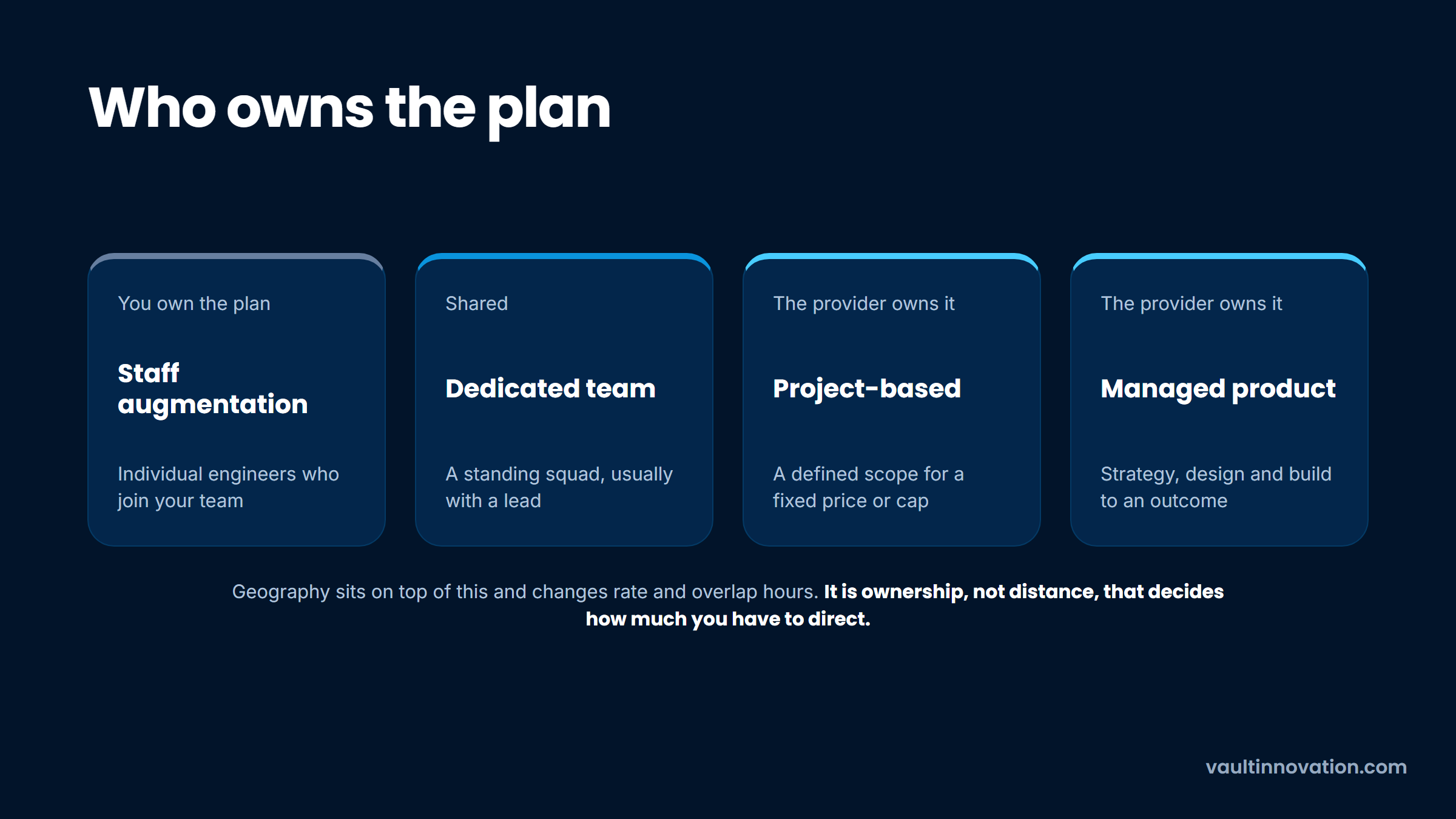
A useful rule: the less technical leadership you have in-house, the further right you should sit on that table. Buying raw hours when nobody on your side can direct them is how budgets disappear. If you are weighing capacity models specifically, our breakdown of staff augmentation covers where that one fits and where it does not.
The stereotype is that companies outsource to spend less. That was true for a long time, and it is now incomplete.
Deloitte's 2024 Global Outsourcing Survey, which gathered insights from more than 500 executives globally, found that skilled talent and agility have joined cost reduction as primary drivers rather than sitting behind it.
The same research found 83% of surveyed executives were already using AI as part of their outsourced services. It also found organizations applying outsourcing to front-office and core capabilities like sales, marketing and R&D, rather than confining it to back-office work.
That shift matters for how you read any outsourcing pitch. If a provider's entire argument is a lower hourly rate, they are selling on the one dimension the market has largely moved past.
The reasons that hold up in practice are narrower and more concrete:
Hiring senior engineers is slow, and the slowness has a cost. A funded roadmap sitting idle for a four-month search burns runway at exactly the moment speed matters most. An outside team can start in weeks.
Some capabilities are genuinely occasional. You may need an iOS specialist, a data engineer, and a designer for eleven weeks, and then not again for two years. Carrying that as headcount is expensive; renting it is not.
And sometimes you need the strategy as much as the code. A team that has shipped forty products has seen the failure patterns in yours before you have. At VAULT we have found this is where the money actually gets saved, in the features a client decides not to build after discovery, not in the hourly rate.
Speed to a working team is the clearest advantage, and it is not marginal. A competent firm can put a designer, two engineers and a lead on your product inside a month. The equivalent hiring process, from job post through offer acceptance and notice periods, routinely runs two to three times longer.
Capacity that flexes both ways is the second. Layoffs are expensive in money and morale. Ending a contract is a conversation. For work with an uncertain end date, that asymmetry is worth real money.
Third, and most underrated: an outside team has no political stake in your existing architecture. They did not choose the framework, so they have no reason to defend it. The candor that comes from that is often worth more than the code.
Those are the real benefits of outsourcing software development, and the honest limit on all three is that they describe a good provider. None of them are properties of outsourcing itself.
Here is the finding that should shape your expectations more than any vendor case study.
Herbsleb and Mockus published an empirical study in IEEE Transactions on Software Engineering measuring how long the same class of work took when it was split across sites versus done in one place. They used source-control data alongside employee surveys.
In one department, the average single-site work item took about five days from first change to last. Items involving more than one site took 12.7 days, more than two and a half times as long, a difference statistically significant at p < 0.001. A second department showed the same pattern, with multi-site items running 18 days.
The same class of work, timed in one building and then across two.
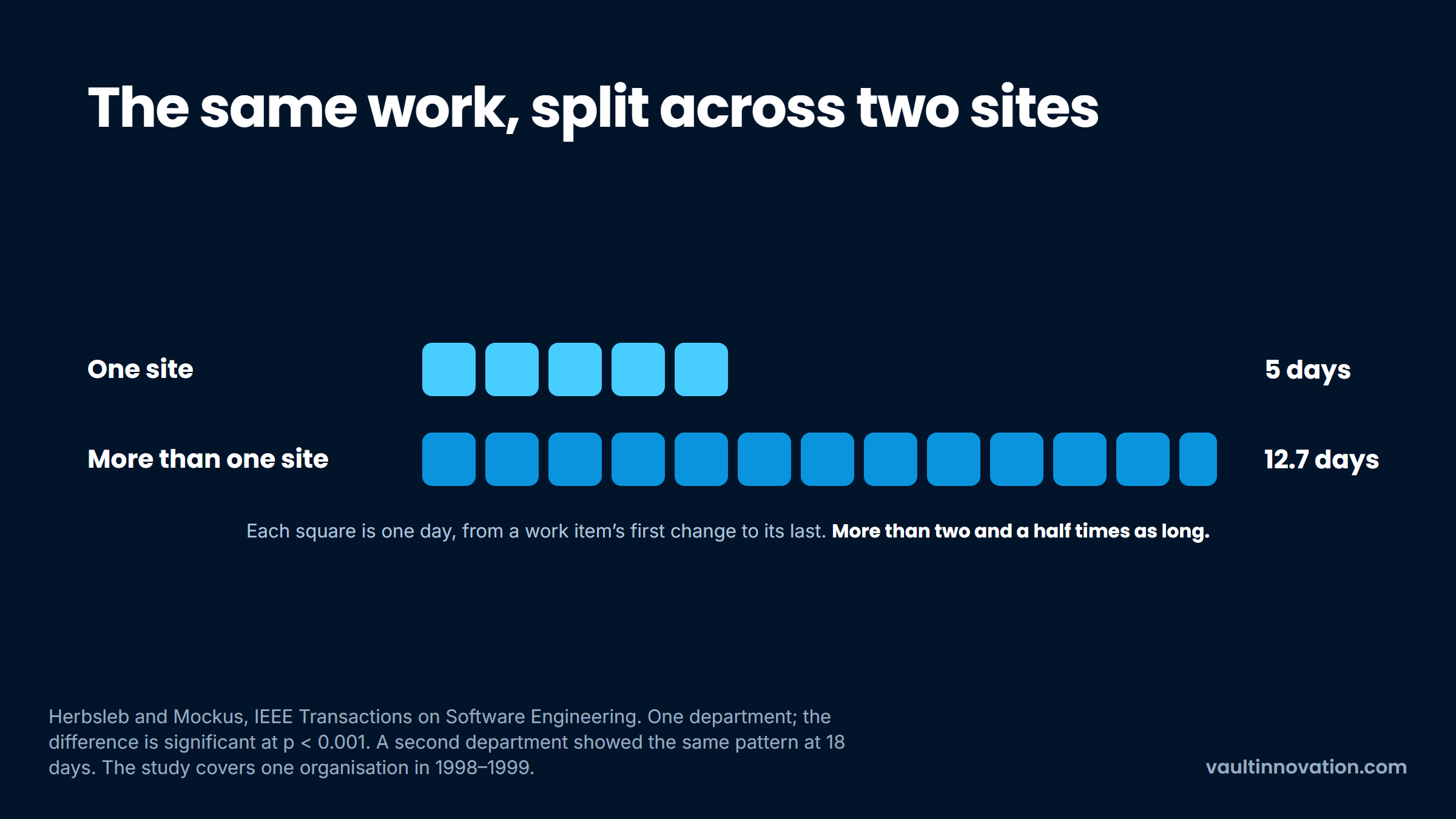
The mechanism they identified is the part worth internalizing: distributed work items involve more people, and the number of people involved is strongly related to how long the item takes. The delay is not caused by distance itself. It is caused by the extra humans that distance requires you to loop in.
The study is old, and it studied one large organization in 1998 and 1999. Modern tooling has genuinely narrowed some of this gap, and the paper was significant enough that IEEE ran a retrospective on it in 2025. But the underlying mechanism has not been repealed. Every handoff you add across an organizational boundary adds people, and people add calendar time.
So when a provider quotes you a timeline, the useful question is not "can you go faster." It is "how many people will touch a typical change, and how many of them are on your side of the boundary."
Strip away the geography debate and one condition predicts outcomes better than anything else. Someone on your side has to be able to evaluate what you are being handed.
This came through clearly in a thread on Reddit where founders debated the same question. The most useful contribution was not a recommendation either way.
The point that landed was simpler. If you are technical enough to judge the quality of the developers you work with, outsourcing goes well. If you are not, you have no way of knowing whether the team is any good until it is far too late to matter.
Another contributor added the practical version: if you are non-technical, avoid one-off freelancers and engage a firm on defined deliverables. These are individual opinions rather than data, but they match what goes wrong in practice.
The failure this describes is specific. You get a product that demos beautifully and cannot be extended. The screens work. The foundation underneath will not carry the next twelve months of roadmap, and you find out when you try to build feature nine.
You probably lack the judgment layer if several of these are true:
If that list stings, the fix is not to abandon outsourcing. It is to buy the judgment separately: a fractional CTO, a paid code review at defined milestones, or a firm that will genuinely explain its decisions to a non-technical owner. That layer typically costs a small fraction of the build and is the highest-return money in the entire engagement.
Rates vary more by model and seniority than by any other factor, and published rates are best treated as a starting bracket rather than a quote.
For reference, Clutch lists our own average hourly rate at $150 to $199, with projects starting around $10,000, which is typical for a US firm doing custom product work. Offshore rates commonly run well below that, and large consultancies well above it.
The trap is comparing rates instead of comparing totals. A team at half the rate that takes three times as long, and needs a rebuild in year two, was never cheaper. The coordination research above is precisely why that scenario is common rather than hypothetical.
Judge a quote on three things instead: what is explicitly out of scope, who is accountable when an estimate is missed, and what you own at the end. We break the full picture down in our guide to software development costs, including how to build an estimate you can actually defend.
The decision is more tractable than the debate suggests, because the two options are strong in different places.
| Situation | Outsource | Hire in-house |
|---|---|---|
| Software is your core product and durable advantage | Only for surge capacity | Yes |
| Defined project with a real end date | Yes | No |
| You lack technical leadership entirely | Yes, managed model plus review | Not yet |
| Specialist skill needed briefly | Yes | No |
| Roadmap is continuous and unpredictable | Dedicated team | Yes, eventually |
| Speed to market decides the outcome | Yes | Rarely fast enough |
| Domain knowledge is the hard part, not the code | Hybrid | Yes |
Read that table as a sequence rather than a fork. Most companies that get this right outsource first to reach a working product, then bring engineering in-house once the roadmap becomes continuous and the domain knowledge starts compounding.
Drawn as a sequence, the two options stop competing with each other.
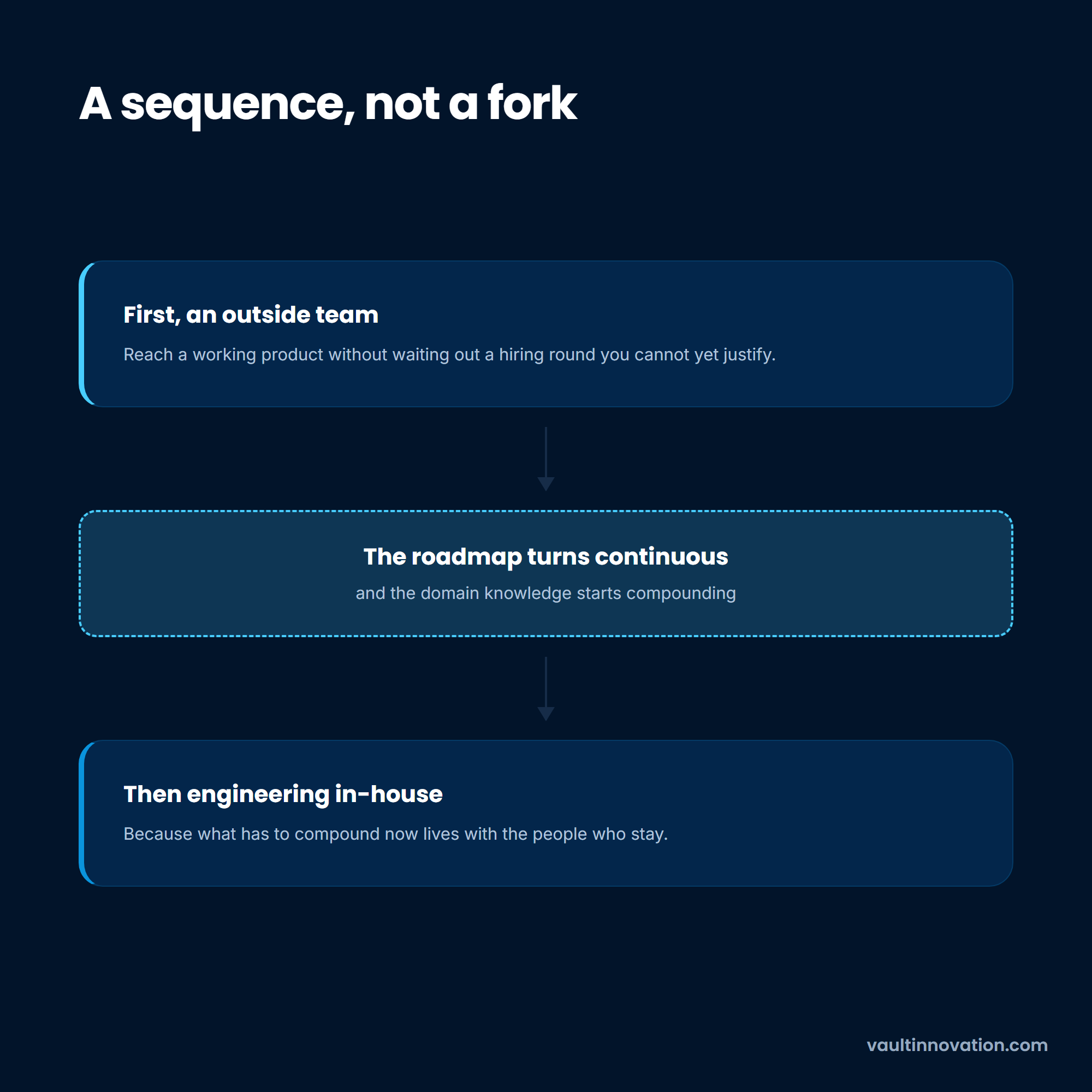
Starting with an outside team does not commit you to one forever. If you are choosing among local firms, our roundup of Chicago software companies shows what that market actually looks like.
There is a case where outsourcing is genuinely the wrong answer, and it deserves stating plainly by a firm that sells the service.
When the product you sell is the software, and the hard part is accumulated understanding of your customers rather than the engineering itself, that understanding needs to live with people who stay. Every contract that ends walks some of it out the door. Documentation slows the loss; it does not prevent it.
The other case is volume. Past a certain amount of continuous work, an in-house team is simply cheaper per unit of output, and the crossover comes sooner than most founders expect. If you have had four or more engineers busy for eighteen straight months with no end in sight, run the numbers on hiring.
Our guides on building a technical team and hiring a software developer cover that transition in detail.
Most of the risk is retired before any code exists, in how you run the selection and the first month.
Treat this as recruiting a team rather than buying a commodity, and sequence it:
Step four is the one people skip and the one that pays. A paid discovery or a small scoped module tells you more about how a team communicates under real conditions than any reference call, and it costs a fraction of discovering the same thing in month five.
Ask for working software in an environment you can open within the first two weeks, even if it does almost nothing. A team that cannot ship a deployed skeleton quickly will not ship a complex product predictably.
The first two weeks are the test, and the deliverable is not a demo.
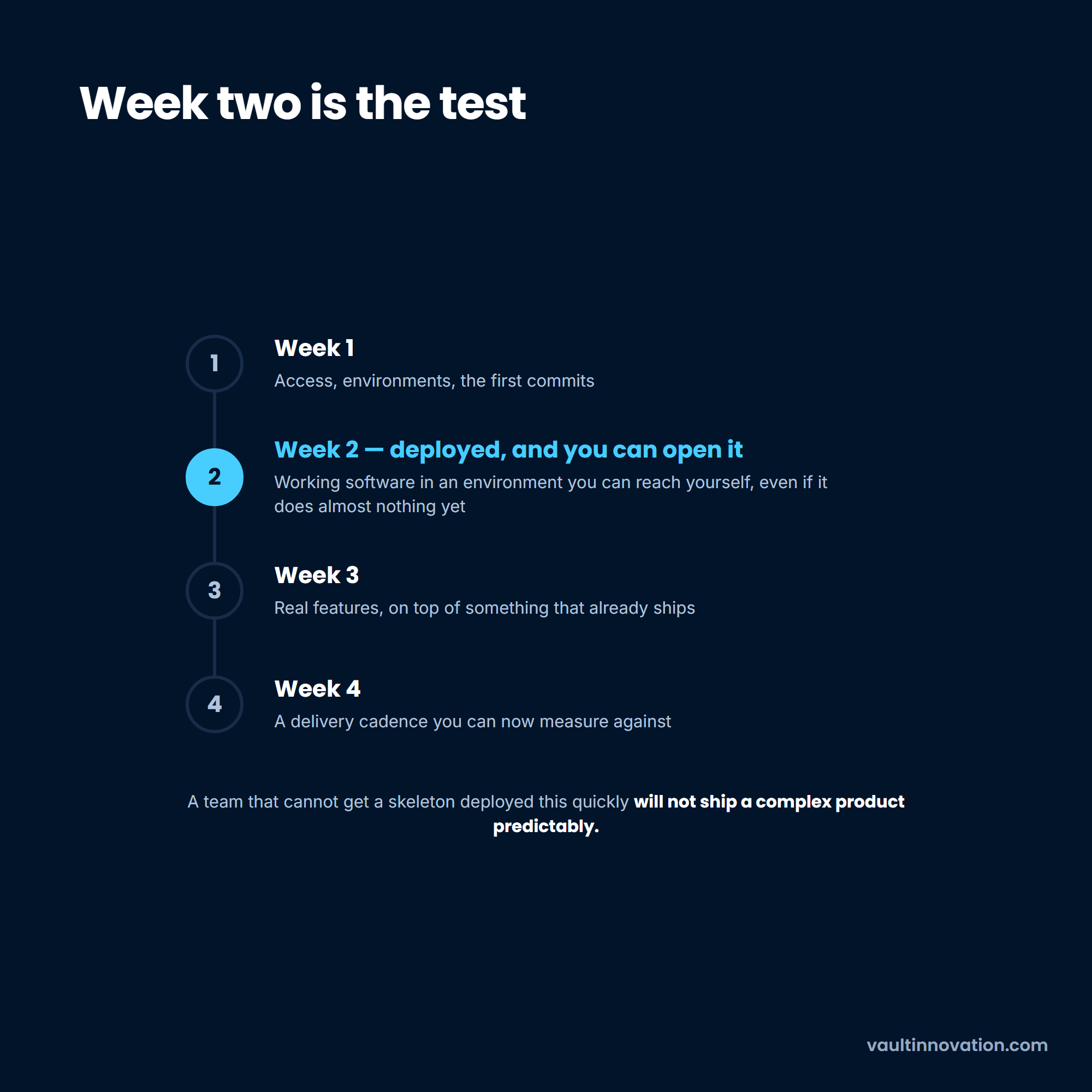
Then insist that estimates arrive broken into pieces small enough to be wrong cheaply. Any task estimated at more than a week is a task nobody has thought through yet.
Our guide on hiring an outsourced team goes deeper on the evaluation questions worth asking.
The commercial terms matter more than the rate, and a few of them decide whether you have an asset or a hostage situation at the end.
That last one gets waved away in good times and matters enormously in bad ones. A clean handover is the difference between changing providers and rewriting from scratch, which is a decision we have walked clients through in moving between development teams.
Honest Game is worth describing because it is the case outsourcing is actually for.
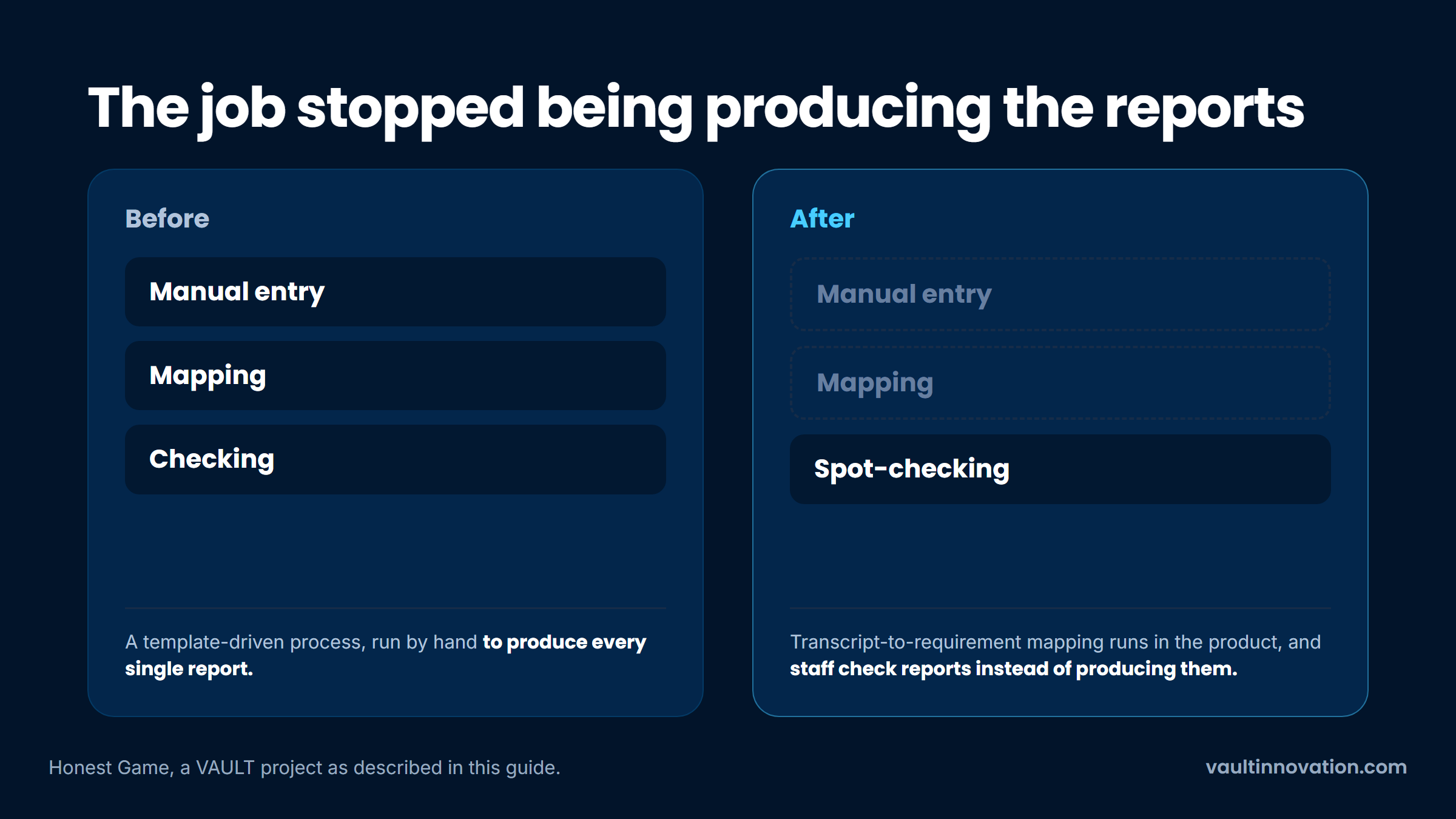
The company had a genuinely hard domain problem: student athletes could not easily tell whether their high school transcripts met NCAA eligibility requirements, and the existing process was template-driven, requiring manual entry, mapping and checking to produce every single report. The founders held the domain expertise. What they did not have, and did not want to spend a year hiring, was a product team.
We built the design system, the marketing site, and a web application that automated the transcript-to-requirement mapping, along with dashboard metrics, CARE plan summaries, and district-level dashboards for high schools, serving three different user groups with different needs. The result was that manual report production stopped being the job. Staff moved to spot-checking reports rather than producing all of them by hand, and the product reached students internationally.
Before and after, the same reports, produced two very different ways.
"The developers from Vault Innovation were smart, skilled, and always available to resolve our issues," said Kim Michelson, Co-Founder and CEO of Honest Game.
Two things made that work, and neither was the hourly rate. The founders knew their domain well enough to judge whether the mapping logic was right, which is the prerequisite from earlier in this guide. And the scope was a real product outcome rather than a pile of tickets. You can read the full Honest Game project, or see how we structure custom software development engagements generally.
Good, under conditions that are entirely knowable in advance, and bad in a way that is expensive and slow to detect when those conditions are absent.
Outsourcing software development is the right call when the work has a definable outcome, when speed matters more than accumulating internal knowledge, when the capability is specialist or temporary, and above all when someone on your side can evaluate what comes back.
Outsourcing is the wrong call when the software is the business, when the hard part is domain knowledge that has to compound internally, and when nobody can tell a solid foundation from a good demo.
Notice that none of those conditions mention a country or an hourly rate. The debate is usually framed around geography because geography is easy to argue about. The variables that actually decide the outcome are scope clarity, the number of people between a decision and a deployment, and whether you have bought yourself the ability to judge the work.
If you are weighing this decision for a specific product, that is a conversation worth having before you write the brief rather than after. Contact us and we will tell you honestly which of the two answers fits your situation.
Usually on rate, sometimes on total cost, and not always. A lower hourly rate is only a saving if the work takes a comparable amount of calendar time and the result does not need rebuilding.
Factor in your own management time, the coordination overhead of splitting work across sites, and any code review you buy separately. Compare fully loaded totals over eighteen months rather than rates.
The costly one is a product that demos well but cannot be extended, which typically surfaces months after launch. Behind that sit scope disputes on fixed-price contracts, key engineers being swapped out quietly, IP and source control you do not actually own, and calendar delay from splitting work across sites.
Each of these is addressable with contract terms and a review cadence agreed before the work starts, which is why the selection stage matters more than the negotiation.
Buy the judgment layer separately and engage on outcomes rather than hours. That means a managed engagement where the provider owns the plan, plus an independent technical review at defined milestones, or a fractional CTO who reads the code on your behalf.
Avoid buying raw hours you cannot direct. Ask for deployed working software in the first two weeks, and require estimates broken into pieces small enough that being wrong is cheap.
Outsourcing works well for startups that need to reach a validated product before they can justify or afford engineering headcount, which describes most pre-revenue and early-revenue companies.
The caution is to avoid locking in a structure you cannot exit. Keep source control in your own accounts, get IP assigned on payment, and treat the arrangement as a stage rather than a permanent model, because once the roadmap becomes continuous the economics start favoring an in-house team.
Embedded and firmware work follows the same logic with two amplifiers. The specialist skills are genuinely rare and rarely needed full time, which strengthens the case for outsourcing, while the feedback loop is slower because hardware cannot be redeployed like a web service.
That combination raises the value of tight scope and hardware-in-the-loop testing agreed up front. We coordinated exactly this kind of software and electrical engineering split on a wearable product, and the plan for that coordination mattered more than any individual skill on the team.