
Blog
.jpg)
Key takeaways:
Search for SaaS development companies and you get the same ten names in a different order, republished from directory rankings nobody checked. Lists of SaaS software development companies rarely say where a firm actually sits, what it costs to start, or what it has stopped doing.
This one does. Each entry carries a headquarters read off the company's own contact page, its recorded Clutch figures, its entry price, and the specific kind of SaaS work it fits. We are VAULT, we build custom software and products out of Chicago, and we are first on this list with our real limitations stated alongside everyone else's.
Two candidates were dropped along the way for reasons worth knowing, and we say who and why rather than quietly trimming the list.
A SaaS development company builds and operates multi-tenant software that customers subscribe to, which is a different job from building an internal tool for one organization.
The difference is architectural and it shows up early. Multi-tenancy, per-customer configuration, usage metering, subscription billing, self-service onboarding and tenant-level data isolation are all decisions made in the first weeks, and they are expensive to retrofit later.
Most firms in this category cover product discovery, UX, engineering, cloud infrastructure and ongoing support. Some also supply the strategy layer, deciding what to build and in what order, which matters more than it sounds when the product is the business rather than a cost center. If you have no technical leadership in place, that gap is worth closing first, whether through an agency or a fractional CTO arrangement.
The table below is a shortlisting tool rather than a ranking. Headquarters and entry price will eliminate more options in two minutes than a week of calls.
| Company | Best for | Headquarters | Clutch | Entry point |
|---|---|---|---|---|
| VAULT | Founders who need strategy plus a build | Chicago, IL | 4.6 / 28 | $10,000+ · $150-199/hr |
| thoughtbot | Senior US engineering on high-stakes work | New York, NY (per Clutch) | 4.9 / 39 | $10,000+ · $150-199/hr |
| ScienceSoft | Regulated industries, published pricing | McKinney, TX | 4.8 / 42 | $5,000+ · $50-99/hr |
| Railsware | Teams who want their builder to own SaaS too | Krakow, Poland | 4.9 / 19 | $50,000+ · $100-149/hr |
| Brocoders | SaaS MVP through to product stage | Tallinn, Estonia | 5.0 / 37 | $10,000+ · $50-99/hr |
| Intellias | Large, long-running engineering programs | Lviv, Ukraine | 4.9 / 30 | $50,000+ · $50-99/hr |
| Intellectsoft | Enterprise clients and AI-led delivery | Palo Alto, CA | 4.9 / 46 | $50,000+ · $50-99/hr |
| Netguru | Commerce platforms and marketplaces | Poznan, Poland | 4.8 / 73 | $50,000+ · $50-99/hr |
| Clockwise Software | Cost-conscious outsourced delivery | Dnipro, Ukraine | 4.9 / 23 | $50,000+ · $50-99/hr |
| Uptech | Finance and healthcare products | Kyiv, Ukraine | 4.9 / 44 | $25,000+ · $25-49/hr |
Read the entry-point column first and the rating column last. Every firm here sits between 4.6 and 5.0, so ratings separate almost nothing, while a $5,000 floor and a $50,000 floor describe genuinely different businesses.

VAULT is a Chicago product firm that has been building software since 2012, mostly for founders and operating teams whose product is the business rather than a supporting tool.
Where we earn our place among SaaS product development firms is early, when the architecture questions are still open. Multi-tenancy, how customers get configured, and what gets metered for billing are decisions that shape the next three years, and we would rather argue about them in week two than refactor around them in year two.
Core services:
Industries served: healthcare, edtech, logistics, supply chain, sports performance
Pricing: Nothing is published, since the number depends entirely on scope. Clutch's third-party record puts us at $150 to $199 hourly, with $10,000 the smallest engagement it lists. Hourly, fixed-cost, staff-augmentation and custom arrangements are all available.
Pros: we argue about scope before writing code, senior people are reachable without an account manager, strategy and engineering sit in one team, 4.6 across 28 public reviews, fully US-based with complete time-zone overlap
Cons: a 10 to 49 person team rules us out of very large multi-team programs, Clutch puts our client mix at 100% small business so we are no one's enterprise vendor, and schedule is our weakest sub-score at 4.4, which is honest feedback about complex builds running long
Notable work: Leaf Trade, a two-sided wholesale marketplace covering storefront, cart, bulk ordering and a REST API, built on Django, PostgreSQL and React. Leaf Trade went on to raise $22.5 million across three rounds, starting with a $4.5 million seed, and was acquired by LeafLink in November 2024. The full platform build is written up on our site, including a live data migration that cut over with only minutes of downtime.
Engagement model: Paid discovery first, producing a scope and a defensible cost. Delivery then runs as one squad with a named lead who stays with the account rather than rotating off it.
What the first month looks like: An intro call to understand the product and its constraints, then a written plan within roughly a week covering scope, engagement shape and who would be assigned. Discovery follows, validating that plan against real users and firming up the number, and you see running software in an environment you can open well before the build is finished.
Why we belong on this list: Very few firms our size sell the product decision and the engineering together, and on a SaaS build the sequencing of the roadmap is worth more than raw delivery capacity.
Final verdict: A good fit when you need senior attention and a defensible plan before committing budget. Wrong call if you need a delivery organization measured in hundreds of engineers, or your roadmap is already settled and you simply want hands. Contact us to talk through a specific product.

thoughtbot has been building software since 2003 and leads with senior experience rather than scale, positioning itself around reliable delivery under complex constraints.
Its Clutch record is among the strongest here at 4.9 across 39 reviews, and its rate band matches US senior firms rather than offshore ones.
Core services: product design, web and mobile engineering, platform and infrastructure work, team augmentation
Industries served: a broad commercial mix, with healthcare among its published focus areas
Pricing: A $10,000 minimum against a $150 to $199 rate, which is an unusually accessible floor for a firm in that band.
Pros: long track record, senior-weighted teams, strong public review record, low entry point for US rates
Cons: at 50 to 249 people it is not built for very large programs, the US rate band is roughly triple the Eastern European firms here, and its own site blocks the tooling we use to verify a headquarters, so the New York location below comes from Clutch rather than from thoughtbot
Notable work: an extensive published case-study library across consumer and B2B products
Why it made this list: It is the clearest example of the senior-US-team model, and its $10,000 floor makes that model reachable for a small first engagement.
Final verdict: Worth a conversation when engineering judgment matters more than headcount and you can fund US rates.

Founded in 1989, ScienceSoft is the oldest firm on this list by a wide margin, and it runs from McKinney, Texas, in the Dallas area.
It leads with AI transformation and software development, and organizes its site around regulated verticals: healthcare, insurance, investment and lending.
Core services: custom software development, AI and data services, QA and testing, application modernization
Industries served: healthcare, insurance, investment, lending, manufacturing
Pricing: $50 to $99 an hour with a $5,000 minimum, the lowest entry point here. It is also one of very few firms in this category with a public pricing section on its own site.
Pros: 35-plus years in business, a US headquarters at offshore-adjacent rates, unusual pricing transparency, deep regulated-industry experience
Cons: at 250 to 999 people across multiple countries your team may not sit in Texas, the breadth across many industries and services can mean less depth in any one, and a firm this size rarely gives a small SaaS project senior attention by default
Notable work: insurance claim platforms and lending systems, with a published portfolio by vertical
Why it made this list: The combination of a verifiable US headquarters, a $5,000 floor and published pricing does not exist anywhere else in this category.
Final verdict: A sensible first call if your SaaS touches healthcare, insurance or lending and compliance experience is non-negotiable.

Railsware calls itself a product studio, and the label is earned: alongside client work it builds and owns its own SaaS products, including Mailtrap, Coupler and TitanApps.
That changes the conversation. A firm running its own subscription products has lived through billing, churn, support load and infrastructure cost in a way a pure services shop has not.
Core services: product management, SaaS engineering, data and integration work, product design
Industries served: developer tools, data tooling, productivity and business software
Pricing: $100 to $149 an hour with a $50,000 minimum, sitting between the US and Eastern European bands.
Pros: genuine product ownership experience, a distinctive product-management-led method, strong Clutch rating at 4.9
Cons: 19 reviews is the thinnest public record here, the $50,000 floor rules out small first engagements, and a studio splitting attention between client work and its own products is a real trade-off you should ask about directly
Notable work: Mailtrap, Coupler and TitanApps, all its own products rather than client references
Why it made this list: Very few agencies can point at subscription products they own and operate, and for a SaaS build that experience is directly transferable.
Final verdict: Strong choice when you want a builder who has run the business model you are about to enter, and you can clear the $50,000 entry.

Brocoders is the most explicitly SaaS-focused firm here. Its homepage headline offers an on-demand technical team for SaaS products and midsize businesses, from MVP through to a mature product stage.
Based in Tallinn and founded in 2014, it carries a perfect 5.0 rating across 37 reviews, the only unblemished record on this list. Among MVP development companies used to create your own SaaS from scratch, that combination of focus and record is rare.
Core services: SaaS product development, MVP builds, dedicated teams, cloud and DevOps
Industries served: logistics, fintech, healthcare, marketplaces
Pricing: $50 to $99 an hour with a $10,000 minimum, a combination that makes a small first project genuinely viable.
Pros: explicit SaaS positioning rather than general software, 5.0 across 37 reviews, low floor at a low rate, MVP-to-scale framing that matches how products actually grow
Cons: at 50 to 249 people it cannot absorb a very large program, an Estonian base means limited time-zone overlap with US West Coast teams, and the on-demand team model works best when you already have someone able to direct it
Notable work: a published case library across logistics and marketplace products
Why it made this list: It is the closest match on this list to the literal search, a company whose stated business is building SaaS products.
Final verdict: A strong shortlist candidate for a funded startup building its first or second SaaS product on a European delivery model.

Intellias is the largest firm here, at 1,000 to 9,999 people, running from Lviv with a second Kyiv office and operating since 2002.
It positions around AI-enabled product engineering and is notably strong in mobility and automotive, which is unusual depth for a firm of this size.
Core services: product engineering, platform modernization, data and AI, dedicated development teams
Industries served: mobility and automotive, financial services, retail, telecom
Pricing: $50 to $99 an hour with a $50,000 minimum, which reflects a business organized around multi-year programs.
Pros: the scale to staff several parallel teams, long operating history, genuine specialist depth in mobility, 4.9 across 30 reviews
Cons: the $50,000 floor and program-scale model are a poor fit for an early SaaS product, 30 reviews is modest for a company of this size, and at this headcount your account team's seniority varies more than at a boutique
Notable work: long-running automotive and mobility engineering programs
Why it made this list: When a SaaS product needs to scale into a platform with several workstreams at once, few firms in this rate band can actually staff it.
Final verdict: The right call for an established product entering a multi-team phase, and the wrong one for a first release.

Intellectsoft runs from Palo Alto with offices in London, New York and Oslo, and leads with AI-first software engineering.
Its client logos skew larger than most firms here, naming Eurostar, Young Living, Melco and Sony on its homepage.
Core services: custom software engineering, AI and data, cloud, digital transformation
Industries served: construction, healthcare, hospitality, retail, financial services
Pricing: $50 to $99 an hour with a $50,000 minimum, an enterprise-oriented structure at mid-band rates.
Pros: a California headquarters with global offices, recognizable enterprise clients, 4.9 across 46 reviews, breadth across AI and cloud
Cons: the $50,000 floor is steep for an early product, enterprise-weighted delivery can be heavier than a startup wants, and the AI-first framing is now common enough that it says little on its own
Notable work: published enterprise engagements across construction and hospitality
Why it made this list: It is one of the few firms here with a verified US headquarters and a client list at that scale.
Final verdict: Consider it when your buyers are enterprises and your vendor needs to look credible to their procurement team.
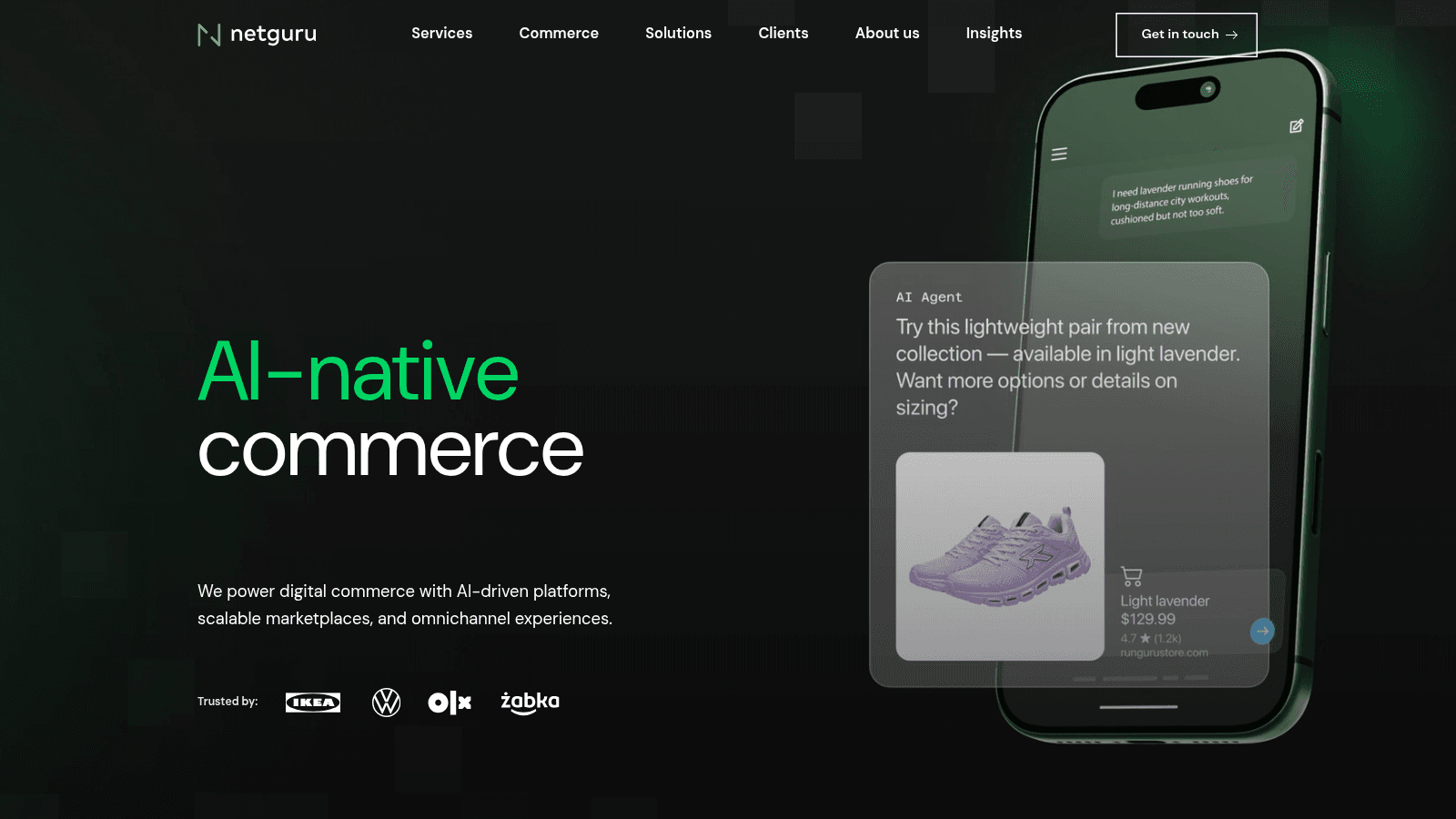
Netguru has the deepest public review record on this list at 73 reviews, and works from Poznan with clients including IKEA, Volkswagen, OLX and Zabka.
One thing to know before you shortlist it: its homepage now leads with AI-native commerce, describing digital commerce platforms, marketplaces and omnichannel experiences. That is a narrower proposition than the general product studio it was known as.
Core services: commerce platforms, marketplace engineering, AI-driven product work, design
Industries served: retail and commerce, marketplaces, consumer brands
Pricing: $50 to $99 an hour with a $50,000 minimum.
Pros: the strongest review volume here at 4.8 across 73, recognizable European enterprise clients, real marketplace and commerce depth
Cons: the commerce repositioning makes it a narrower fit for general B2B SaaS, the $50,000 floor rules out small engagements, and at 250 to 999 people the team you meet may not be the team you get
Notable work: commerce and marketplace platforms for large European retail brands
Why it made this list: If your SaaS product is a marketplace or has commerce mechanics at its core, this is the most directly relevant firm here.
Final verdict: A strong fit for commerce-shaped products, and a mismatch for a straightforward B2B SaaS tool.

Clockwise describes itself plainly as a software development outsourcing company, offering AI-assisted development with senior engineers and full accountability per feature.
Founded in 2014 and based in Dnipro, it carries a 4.9 rating across 23 reviews and features an Eventbrite testimonial on its homepage.
Core services: outsourced product development, web and mobile engineering, AI integration, dedicated teams
Industries served: education, logistics, IT consulting, environment and martech, per its own case index
Pricing: $50 to $99 an hour with a $50,000 minimum.
Pros: direct and unembellished positioning, senior-engineer model, 4.9 rating, a recognizable reference client
Cons: 23 reviews is the second-thinnest record on this list, the $50,000 minimum is high relative to its size, and outsourcing framing means you supply the product direction rather than buying it
Notable work: an Eventbrite engagement referenced directly on its homepage
Why it made this list: It is honest about being an outsourcing company rather than dressing that up, which makes it easier to evaluate for what it is.
Final verdict: Suitable when you have clear product direction in-house and need capable delivery capacity attached to it.

Uptech works from Kyiv with a second office in Gdansk, and focuses on finance and healthcare products, framing its work as building intelligent software for those sectors.
It has the lowest rate band on this list at $25 to $49 an hour, paired with a $25,000 minimum.
Core services: product design, mobile and web development, AI integration, talent augmentation
Industries served: fintech, healthcare, wellness, real estate
Pricing: $25 to $49 an hour with a $25,000 minimum, the lowest rate here by a clear margin.
Pros: the most affordable rate band on this list, 4.9 across 44 reviews, genuine vertical focus in finance and healthcare, offices in two countries
Cons: the lowest rate band means more of the delivery risk sits with your own oversight, founded in 2016 it is the youngest firm here, and a fintech or health product will still need compliance expertise you should verify separately
Notable work: a published portfolio across fintech and health products
Why it made this list: It offers the widest gap between rate and public review record of any firm we checked.
Final verdict: Sensible when the budget is fixed and tight, provided you can supply product management from your own side.
Four filters produced this list of top companies for SaaS product development, and the first one removed more candidates than the other three combined.
We verified each headquarters on the company's own contact or about page rather than trusting a directory. Directory listings rank firms that serve a market, not firms based in it, and that distinction quietly misleads readers about where their team will sit.
We then required a public Clutch record with enough reviews to mean something, read each firm's current homepage to confirm it still does what roundups claim, and captured a screenshot of every entry so nothing here is described from memory.
Two candidates did not survive. Simform has the most reviews of any firm we looked at, 87, and Clutch lists it in Orlando, but its own contact and about pages returned no address through any tool we tried.
The second was subtler. A Clutch profile matching the name Upsilon turned out to belong to a different, much smaller company entirely, at 2 to 9 staff and 3 reviews. Quoting its numbers would have described the wrong business under the right name.
Start with whether the firm has built multi-tenant software before, because it is the one capability that does not transfer from general app development. The best SaaS product development agencies will answer this with architecture detail rather than logos, and the ones worth shortlisting tend to volunteer the constraints before you ask.
Ask how they handle tenant data isolation, how they meter usage for billing, and what happens when one customer's data volume grows ten times faster than everyone else's. Vague answers here are the single most reliable early warning available.
Then check the engagement shape rather than the logo wall. A firm that only sells dedicated teams expects you to supply product direction, while a firm that leads with discovery expects to help set it. Neither is better, but buying the wrong one is expensive and the mismatch usually surfaces around month three, which is exactly when handovers become painful.
Practitioners converge on the same two screening steps. In a thread about outsourcing MVP development on Reddit, one commenter recommended setting a small paid exercise before signing anything, noting that agencies routinely overestimate their own speed.
Another insisted on video interviews, having found that candidates who looked strong on paper often had communication skills that made them unworkable. Both are anecdotal, and both cost far less than discovering the same thing in month two.
Match the firm to the stage you are actually at rather than the stage you are pitching. SaaS development firms are not interchangeable across stages, and the mismatch costs more than the rate difference.
If the product is still an idea, you need discovery and a team that will argue with your scope. The best SaaS product development firms at this stage are the ones with a low minimum and a real strategy practice, and a $50,000 floor is a signal you are not their customer yet.
If the product exists and needs to scale into a platform, you need capacity and process, which points at the larger firms even though they cost more to coordinate. If the product exists and the roadmap is clear, an outsourced delivery team at a low rate band is the efficient answer, provided someone on your side owns the roadmap.
One more filter matters and rarely gets applied: time zone. A four-hour overlap is workable and a one-hour overlap is not, regardless of how good the engineering is. Firms in Central and Eastern Europe overlap comfortably with US East Coast mornings and barely at all with the West Coast, and pretending otherwise is how early product momentum quietly leaks away.
Rates on this list fall into three bands, and the band is mostly a function of geography.
| Rate band | Firms here | What the money gets you |
|---|---|---|
| $25 to $49 an hour | Uptech | Lowest cost, more oversight required from you |
| $50 to $99 an hour | ScienceSoft, Brocoders, Intellias, Intellectsoft, Netguru, Clockwise | The Central and Eastern European standard, plus two US firms operating in it |
| $100 to $149 an hour | Railsware | Product-management-led delivery at a mid band |
| $150 to $199 an hour | VAULT, thoughtbot | US-based senior teams, full time-zone overlap |
Minimum project size is the more decisive number, and it ranges from $5,000 at ScienceSoft to $50,000 at five of these firms. A six-figure-adjacent floor is not a statement about quality, it describes a company organized around larger programs.
The market context is worth knowing when you budget. Gartner's July 2026 forecast puts worldwide software spending at $1.47 trillion in 2026, growing 15.5%, while IT services grows just 5.3% to $1.57 trillion. That services line now leaves out cloud infrastructure, which Gartner reports separately at $287 billion, so it reads lower than the figure in Gartner's earlier forecasts.
Buyers are putting money into software products considerably faster than into the services that build them, which is why good SaaS teams stay busy and why rates have not softened.
The honest comparison is not agency rate against salary, because those numbers are not equivalent.
US Bureau of Labor Statistics figures put the median annual wage for software developers at $133,080 as of May 2024, with software quality assurance analysts and testers at $102,610. Add benefits, payroll taxes, equipment, recruiting and management overhead and a loaded cost well above those figures is realistic, before accounting for the months a role sits open.
An agency converts that into a variable cost you can stop. That flexibility is worth a premium early, when scope is uncertain and you may need three specialisms for six weeks each rather than one generalist for a year. It stops being worth the premium once the roadmap is stable and the same people are working on it every month.
The hybrid most SaaS companies land on is a small in-house core owning architecture and roadmap, with an agency supplying delivery capacity around it. That structure keeps the burn-rate math manageable through the phase where revenue is still small.
Getting the split right is itself a design problem: which decisions stay in-house, which get delegated, and what has to be written down for the boundary to hold. We work that through with clients as part of our product strategy practice.
Cut on headquarters and time zone first, then on minimum project size, and you will be down to three or four names inside an afternoon. Ratings will not help you, because every firm here sits between 4.6 and 5.0.
Then run the same two screens the practitioners above described: a small paid exercise, and a video call with the people who would actually do the work rather than the people who sell it. Both are cheap and both surface problems that reference calls never will.
Multi-tenant subscription software, which means one codebase serving many customers with their data kept separate. That brings requirements a single-tenant internal tool never has: usage metering, subscription billing, self-service onboarding, per-tenant configuration and isolation.
Most also cover discovery, design, cloud infrastructure and ongoing support. The useful question when comparing firms is whether they have shipped multi-tenant products before, since that architecture is difficult and expensive to retrofit.
Rates across this list run from $25 to $199 an hour, and the band is driven mainly by geography rather than seniority. US-based senior teams sit at $150 to $199, Central and Eastern European firms at $25 to $99.
Minimum project size is the more practical filter, ranging from $5,000 to $50,000 here. Model the total against a loaded in-house cost rather than against salary alone, because benefits, recruiting and management overhead are real and salary figures exclude them.
Often yes, with two conditions. You need enough time-zone overlap for a real working session most days, and someone on your side who owns product direction, because a lower rate band usually assumes you are supplying it.
Where offshore goes wrong is rarely code quality. It is coordination cost: more people per decision, longer feedback loops, and requirements that were clear in writing turning out not to be.
Read the headquarters off the company's own contact page, not off a directory. Directories rank firms that serve a market rather than firms based in it, and we cut two well-reviewed candidates from this list because their own sites would not confirm the basics.
Then check the homepage against your assumption. One firm here has repositioned entirely around commerce since it appeared in earlier roundups, which changes whether it fits a general B2B SaaS product.
Usually not for a first release. Splitting them adds a coordination boundary exactly where the most rework happens, and each side ends up blaming the other for scope that fell between them.
Once a product is established and design becomes a steady stream of refinements rather than foundational decisions, splitting becomes more reasonable. At that point a specialist design team working against a stable system can be genuinely better than a generalist one.
A second opinion on which shape of firm suits your product is most useful before the first proposal lands, because every proposal argues for the shape of the firm that wrote it.
Contact us and we will give you ours. We are happy to say when a lower-cost delivery shop is the better answer than we are, and it happens more often than you might expect.


