
Blog
.jpg)
Key takeaways:
Search for React development companies and you will mostly find lists assembled from directory rankings, where a firm's presence in a country or a city means it bought a listing there.
We checked. Of the firms ranking in Clutch's US React directory, a substantial share are offshore or distributed teams with a US sales address, and at least one well-known name publishes no address at all. Sorting that out took longer than writing the reviews.
What follows is ten react js companies with verified US addresses, real Clutch figures, and an honest note about what each is actually good at. There is also a section on when you should not hire a React specialist, which is more often than this kind of article usually admits.
React is a JavaScript library for building user interfaces. A React development company builds the part of your product people click on, and in almost every real engagement, a good deal more than that.
The distinction matters when you are buying. A pure front-end shop takes a design and turns it into a working interface against an API someone else built. A product engineering firm that uses React designs the data model, builds the API, writes the interface and deploys the whole thing. Both call themselves React companies.
Scope is the question to ask first. If you already have a backend team and need an interface built, the front-end specialist is cheaper and faster. If you are building a product from nothing, hiring someone who only does the interface leaves the hardest decisions unowned.
The gap between those two purchases is where budgets go missing. Software earns its keep by changing how the business runs, and there are ways tech makes money that a beautifully built interface on the wrong data model will never reach.
The selection rule that did the most work here was geographic, and it eliminated more candidates than quality ever did.
A directory listing records where a firm sells, not where it sits. Clutch ranks by the market a firm serves, which is a different question entirely. The clearest illustration we found sits inside Clutch's own data: Saritasa cards as Newport Beach, California in the React directory and as Chicago, Illinois in the Chicago directory, on the same day.
So every firm here had to publish a US street address on its own contact or offices page. We also required a public Clutch profile with at least 15 reviews, evidence of React in production rather than in a services list, and a homepage we could capture.
Three firms were cut on the address rule alone. thoughtbot, probably the best-known Rails and React consultancy in the country, publishes only phone numbers; we tried three independent methods and found no address, so it is not here despite 39 reviews at 4.9. Two others were cut on relevance after reading their own sites, including a Denver studio in the React directory whose team is made up of visual artists and social media specialists.
The table below is the short version. Every rating, rate band and minimum was read off the firm's own Clutch profile on 19 August 2026.
| Company | Best for | Main services | Typical clients | Pricing (from) | Rating |
|---|---|---|---|---|---|
| VAULT | Founders needing strategy plus build | Custom software, mobile, AI, UX | Startups and small business | $10,000+ | ★★★★☆ |
| Orases | Long-running custom platforms | Custom software, AI, strategy | Mid-market | $75,000+ | ★★★★★ |
| Saritasa | Complex modernization work | Software modernization, DevOps, architecture | SMB to mid-market | $50,000+ | ★★★★☆ |
| Crema | Validating what to build | Product strategy, design, engineering | Startups to large brands | $5,000+ | ★★★★★ |
| Six Feet Up | Python backends with React front ends | Python, Django, AI, cloud | Mission-driven organizations | $50,000+ | ★★★★★ |
| RoleModel Software | Software shaped to an odd process | Custom software consultancy | SMB with unusual workflows | $5,000+ | ★★★★★ |
| Twin Sun | Rescuing a stalled build | Custom software, AI infrastructure | Startups and SMB | $25,000+ | ★★★★★ |
| Imaginovation | Budget-conscious custom builds | Custom platforms, integrations, mobile | Startups and SMB | $10,000+ | ★★★★★ |
| Oomph | Content-heavy platforms | Websites, platforms, digital products | Institutions and nonprofits | $25,000+ | ★★★★★ |
| Troy Web Consulting | Modernizing an aging application | Custom software, modernization, consulting | SMB and public sector | $25,000+ | ★★★★★ |
Ratings are rounded to the nearest half star from each firm's overall Clutch score, so read the review counts alongside them. The ten react js companies below are ordered by fit rather than by score, since a perfect rating across 16 reviews and a 4.6 across 28 are not the same evidence.
Best for: Founders who need product thinking
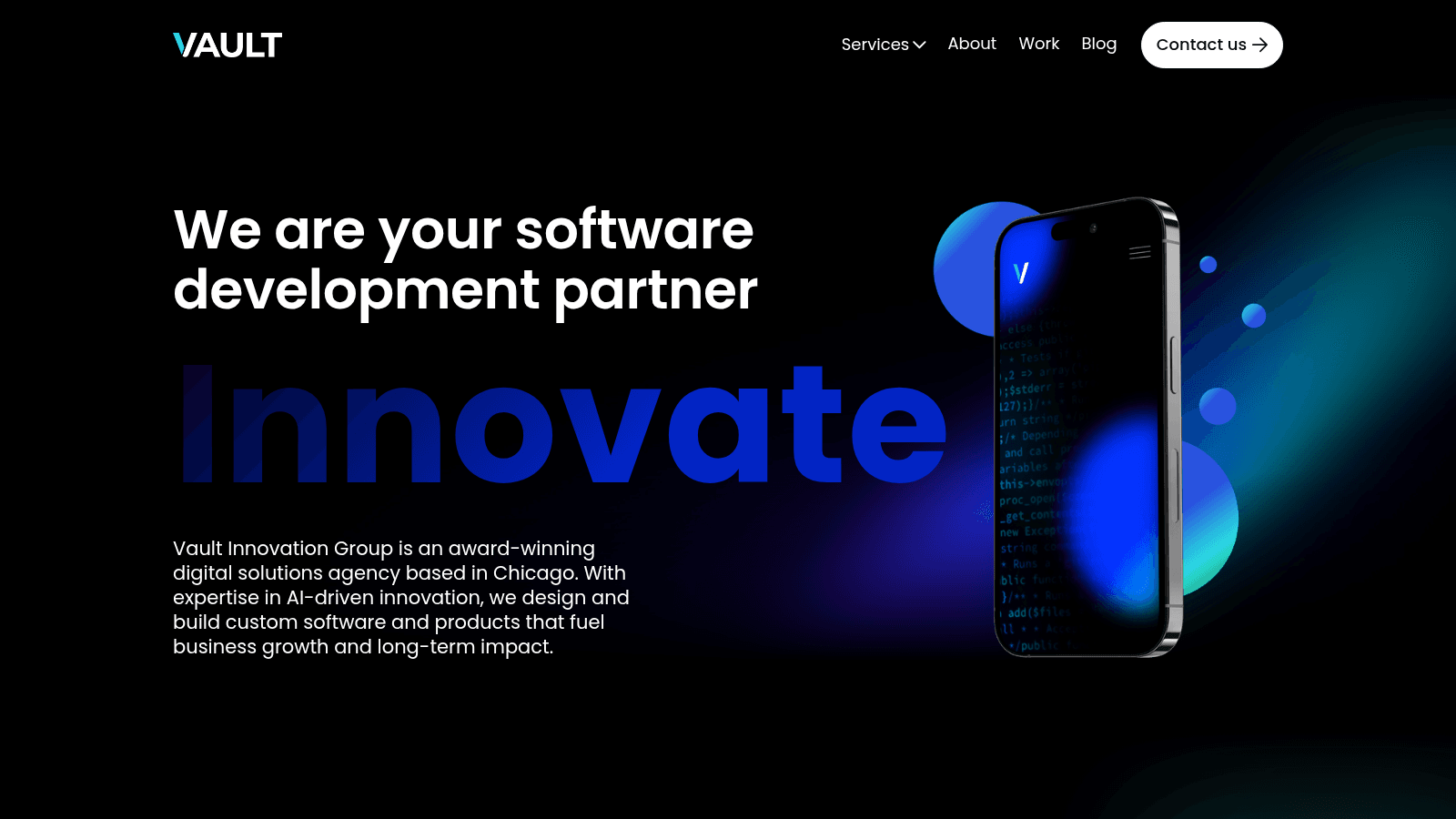
We have built custom software and digital products since 2012, out of a Chicago office on North Wacker and a second one in Raleigh.
React is a large part of how we build interfaces, though we would rather talk about what sits behind it. Our Clutch focus areas record React Native at 30% alongside Django and Laravel on the server, which is an accurate picture of the work: front end and back end from the same team.
The Leaf Trade build is the clearest example. A React front end sat on a Django and PostgreSQL backend, with Redis caching, a forked Saleor commerce framework and a REST API, running in Docker on AWS. The client went on to raise $4.5 million. None of that was a front-end project, and pretending it was would have produced a much worse product.
Core services:
Industries served: healthcare, cannabis supply chain, edtech, logistics, sports performance
Pricing: Nothing is published, because a rate without a scope is not information. What is public is Clutch's record of our work: a $10,000 floor and an average band of $150 to $199 an hour, across hourly, fixed-cost and staff augmentation arrangements.
Pros: front end and back end from one team, discovery before code, US-based with two offices, 4.6 across 28 public reviews, founders talk to senior people
Cons: React is one of several stacks we work in rather than our single specialism, so anyone shopping for a pure React consultancy with no view on the backend will find us opinionated. Our headcount sits in the 10 to 49 band, which puts a genuine ceiling on how many parallel workstreams we can run
Notable clients: Wayward, Leaf Trade, ProduceDesk, Honest Game, iCopy
Engagement model: Most projects open with a paid discovery phase that produces a scope and a real number before anyone commits to a build. After that we run as a dedicated team with a named lead.
What the first weeks look like: an intro call about the objective, a development plan back inside a week, then discovery to pressure-test it. Build starts once the plan survives that, and you get access to a working environment early rather than at the end.
Why we belong on a list of React JS companies: We ship React in production on products that had to scale, and we own the layer underneath it. That combination is what most React briefs actually need.
Final verdict: A good fit for founders and small B2B teams who want the interface and the system designed together. Not the right call for a pure front-end contract or a program needing 200 engineers. Contact us to talk through a specific build.
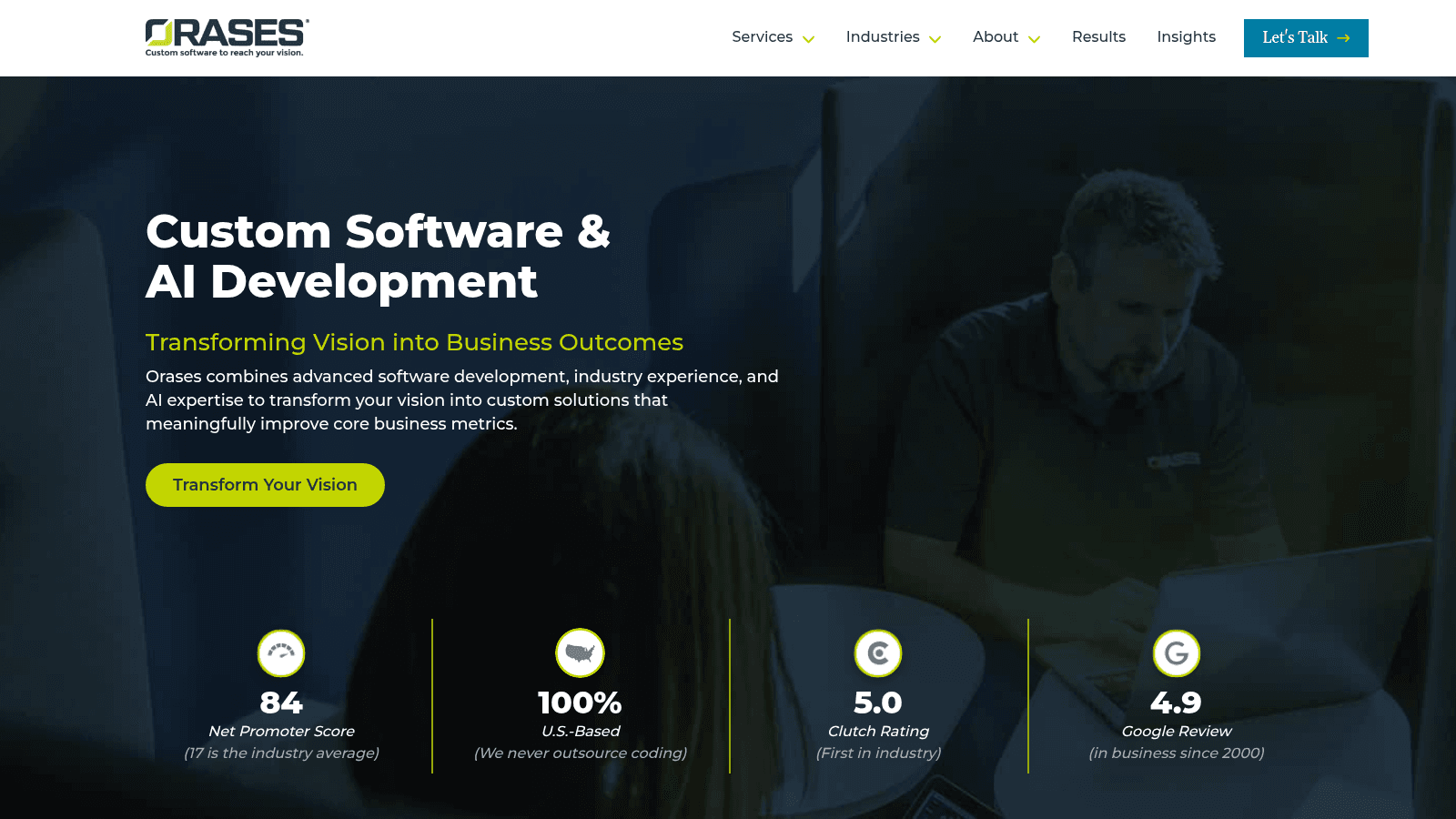
Overview: A Maryland custom software firm at 5728 Industry Lane in Frederick, working with mid-market companies on long-running platforms. Its positioning leans on staying engaged across the whole project rather than delivering and leaving.
Core services:
Industries served: healthcare, finance, manufacturing
Pricing: $150 to $199 hourly, and it will not open below $75,000, the steepest threshold in this roundup. That number tells you who Orases is built for.
Pros: 74 reviews at a perfect score, deep bench at 50 to 249 staff, strategy capability alongside delivery
Cons: the minimum rules out most early-stage work, less visible as a React specialist than as a general custom software firm, East Coast time zone only
Notable work: grant and learning management systems in youth sports, plus long-term platform engagements
Where it fits: Orases suits a company with a funded, multi-year platform where continuity matters more than speed.
Final verdict: One of the strongest records here, priced for organizations with real budgets.
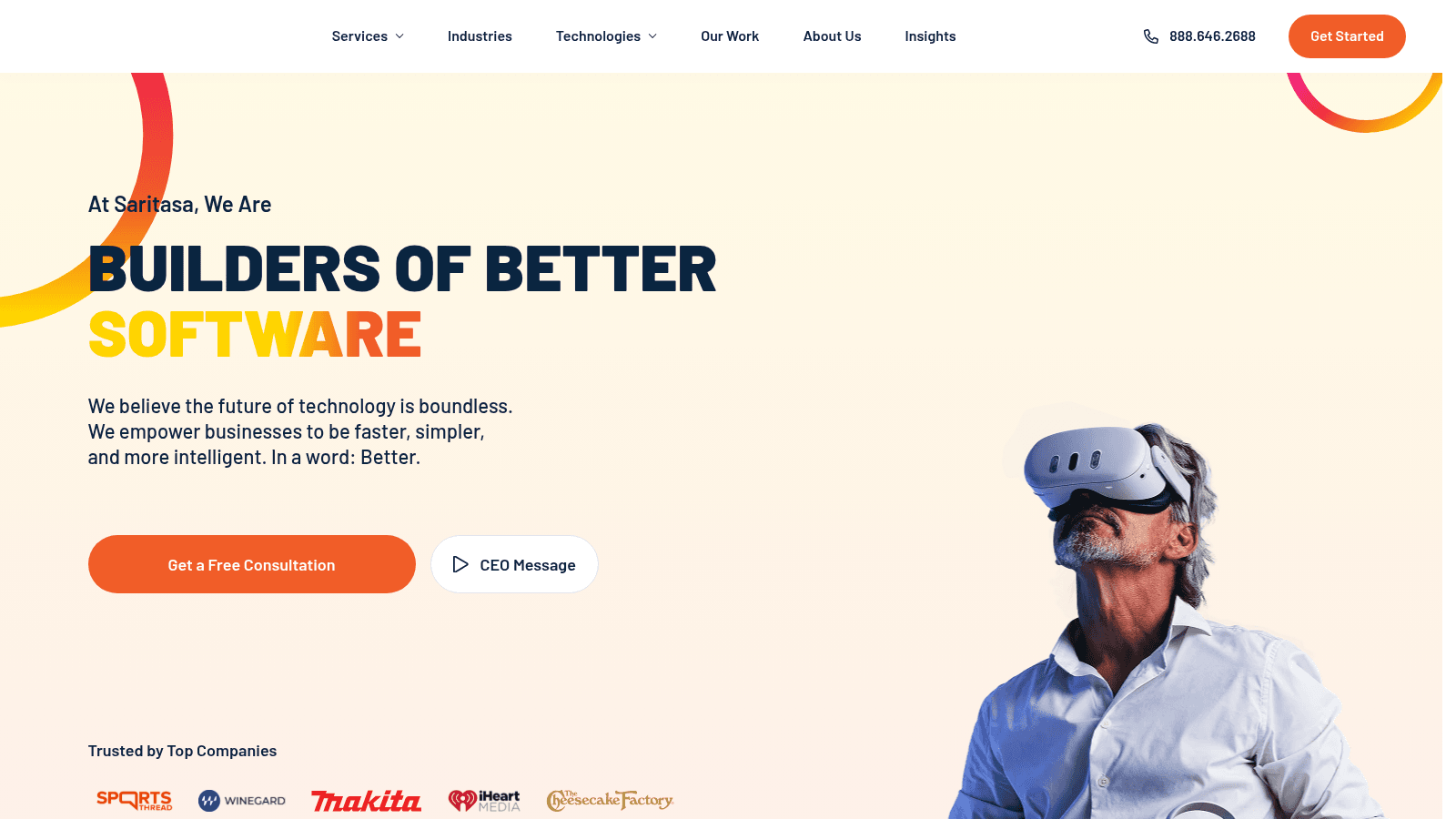
Overview: An Orange County firm at 19900 MacArthur Boulevard in Irvine, with 106 Clutch reviews, the largest review base in this roundup. The work skews toward modernization and architecture rather than greenfield interfaces.
Core services:
Industries served: logistics, real estate, healthcare
Pricing: $100 to $149 hourly, under a $50,000 threshold. Cheaper per hour than the market, more demanding on total commitment.
Pros: 106 public reviews, genuine modernization depth, broad technology coverage across Python, PHP and JavaScript
Cons: the breadth makes it hard to read as a React specialist, 50 to 249 staff means your team composition matters more than the brand, and its Clutch presence spans city directories well beyond Orange County
Notable work: enterprise modernization and dedicated-team engagements across several verticals
Why buyers shortlist it: The review volume alone is unusual, and modernization is a harder skill to buy than new-build.
Final verdict: Best when you have an existing application that needs rescuing rather than a blank page.
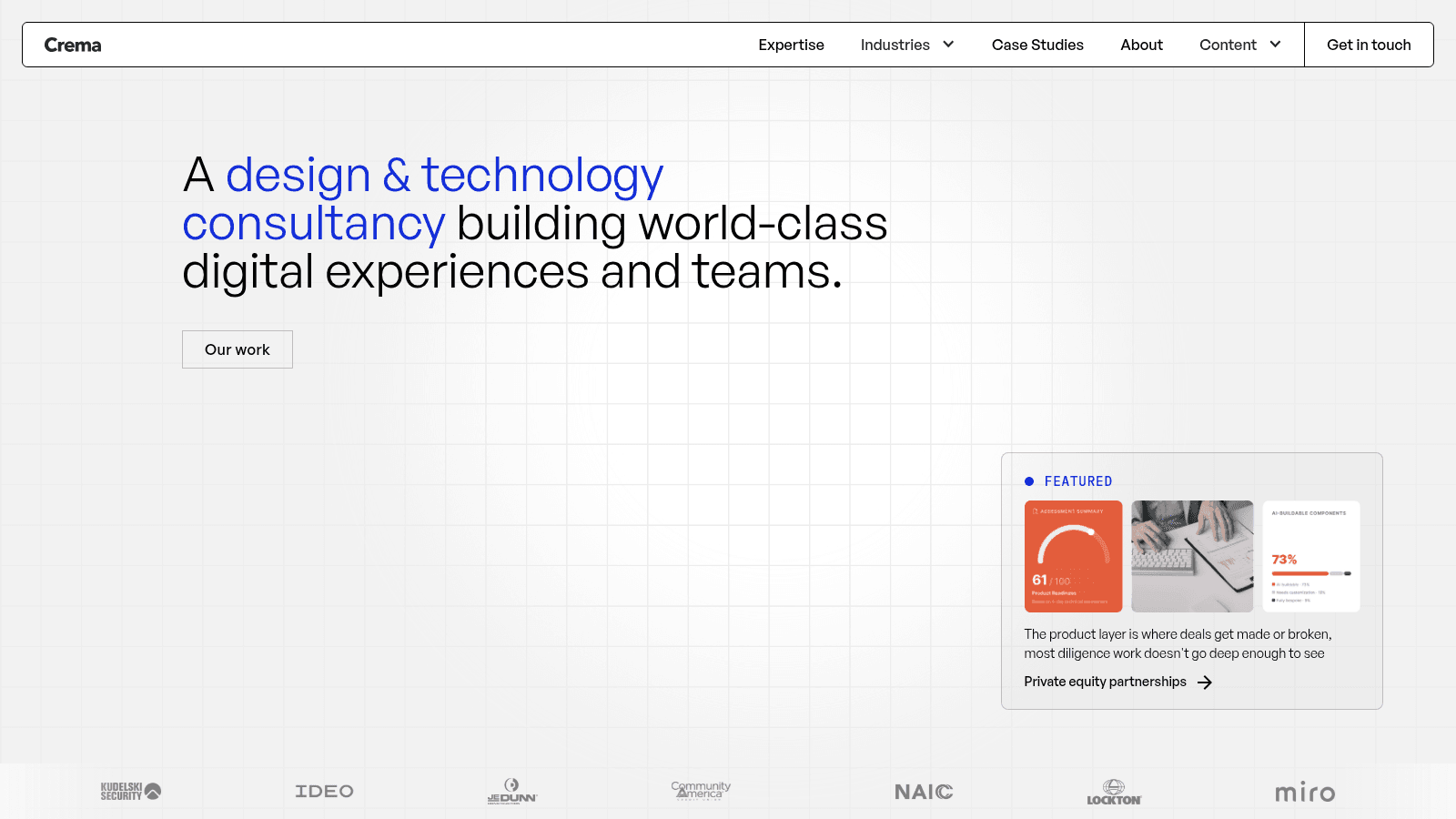
Overview: A Kansas City product agency at 1815 Central Street, founded in 2009. Its pitch is about deciding what is worth building before building it, which is a genuinely different opening move from most React shops.
Core services:
Industries served: insurance, financial services, consumer brands
Pricing: $150 to $199 hourly, and it will open a project for $5,000, the gentlest threshold here. That reflects how much of Crema's work begins as a short discovery piece.
Pros: strong named client list, validation-first approach, small enough for senior attention at 10 to 49 people
Cons: 20 reviews is a modest base for a firm founded in 2009, design and strategy are more prominent than engineering depth, Central time zone only
Notable clients: NAIC, Lockton, Miro, H&R Block, adidas
Its real strength: Crema is set up to tell you your idea needs reshaping, which is worth more than a fast interface build.
Final verdict: A good first call when the product is still an argument rather than a spec.

Overview: An Indiana firm at 11208 Windermere Boulevard in Fishers, describing itself as Python and AI for good and as woman-owned. React appears where it belongs in that stack, on the front of Django and Plone systems.
Core services:
Industries served: research institutions, nonprofits, government-adjacent organizations
Pricing: $200 to $300 hourly, the steepest band in this roundup, under a $50,000 threshold. You are buying deep Python specialism, not general web capacity.
Pros: genuine Python depth, 26 reviews at a perfect score, clear mission-driven focus
Cons: the top rate band on this list, React is a supporting technology rather than the specialism, a 10 to 49 person team
Notable work: long-running Python platforms for research and mission-driven organizations
Where it beats the alternatives: If your backend is Python and your front end is React, this is a much better match than a front-end specialist.
Final verdict: Excellent for Python-heavy systems, wrong if you want a React-first shop.
Overview: A North Carolina consultancy at 2141 E Williams Street in Apex, built around the idea that software should fit the business rather than the reverse. It targets companies whose processes do not match anything off the shelf.
Core services:
Industries served: manufacturing, field services, specialty distribution
Pricing: $150 to $199 hourly, and it will not open below $5,000, which makes a genuinely small first project realistic.
Pros: clear specialism in awkward operational processes, low entry point, published outcomes from named clients
Cons: 25 reviews for a long-established firm, less relevant for consumer products, small team at 10 to 49
Notable work: FieldX, where the published result was quoting time falling from around four hours to roughly 30 minutes
Why it earns a place here: Most React briefs are really operations briefs, and this firm reads them that way.
Final verdict: Strong pick when your process is the product and nothing off the shelf fits it.

Overview: A Nashville firm at 1300 Division Street, with a notably specific line of work: taking over projects that have stalled or gone wrong under someone else.
Core services:
Industries served: healthcare, logistics, professional services
Pricing: $150 to $199 hourly under a $25,000 threshold, a mid-market position that suits rescue work.
Pros: rare and useful specialism in inherited projects, perfect Clutch score across 22 reviews, transparent assessment-first process
Cons: 10 to 49 staff limits parallel workstreams, rescue work is priced by uncertainty, less of a track record on large greenfield builds
Notable work: founder-led platform launches and takeovers of partially-built systems
Why buyers shortlist it: Very few firms will honestly assess someone else's codebase and tell you what is worth keeping.
Final verdict: The first call if a previous team left you with something half-finished.

Overview: A Raleigh firm at 8801 Fast Park Drive, building custom platforms, integrations and mobile applications for companies that want a full build without a coastal rate card.
Core services:
Industries served: healthcare, construction, retail
Pricing: $50 to $99 hourly against a $10,000 threshold, well under every other US firm in this roundup.
Pros: the most accessible rate band on this list, low minimum, broad delivery capability
Cons: 16 reviews is the smallest base here, the rate band raises a fair question about who writes the code and where, less strategy weight than the firms above
Notable work: custom healthcare software for Movement for Life, addressing workflow gaps existing physical therapy systems could not
Where it fits: Budget-constrained builds that still need a real application rather than a template.
Final verdict: Good value, and worth asking directly who writes the code and where they sit.

Overview: A Providence, Rhode Island consultancy at 225 Dyer Street, building websites, platforms and digital products for institutions where reliability matters more than novelty.
Core services:
Industries served: higher education, healthcare, nonprofits
Pricing: $150 to $199 hourly, and it will not open below $25,000. Standard for East Coast institutional work.
Pros: perfect score across 18 reviews, strong fit for content-heavy platforms, experienced with institutional procurement
Cons: more of a digital consultancy than a React product shop, 18 reviews, 10 to 49 staff
Notable work: platforms for organizations with large content estates and long support horizons
What it is genuinely good at: Systems that have to survive a decade of editors rather than a funding round.
Final verdict: Right for institutional platforms, less so for a fast-moving consumer product.

Overview: An upstate New York firm at 135 Mohawk Street in Cohoes, with dedicated practice pages for React, React Native, Angular, Vue, Node and .NET. That breadth is unusual and it tells you the firm meets stacks where they are.
Core services:
Industries served: public sector, manufacturing, professional services
Pricing: $150 to $199 hourly under a $25,000 threshold, right on the US market band.
Pros: genuine multi-framework capability, assessment-led engagements, perfect score across 17 reviews
Cons: 17 reviews, a smaller regional profile than the coastal firms, 10 to 49 staff
Notable work: modernization engagements on legacy line-of-business applications
Why it made this list: A firm that supports Angular and Vue as first-class practices is being honest that React is not always the answer.
Final verdict: A sensible choice for modernizing something that already exists in another framework.
Rates are the least useful number in a proposal, and the minimum project size is the most useful. The table below shows what the ten firms above actually publish.
| Rate band | Firms in this list | What you are typically buying |
|---|---|---|
| $50 to $99 / hr | Imaginovation | Delivery capacity, often with offshore or hybrid teams |
| $100 to $149 / hr | Saritasa | Mid-market delivery with architecture depth |
| $150 to $199 / hr | VAULT, Orases, Crema, RoleModel, Twin Sun, Oomph, Troy Web | The US market default for senior product engineering |
| $200 to $300 / hr | Six Feet Up | Narrow, deep specialism |
The minimum project size ranges from $5,000 to $75,000 across the same ten firms, and that spread tells you far more about fit than the hourly figure does. A firm with a $75,000 floor has structured itself around long engagements and will not enjoy a six-week interface project, whatever its rate card says.
If those numbers are uncomfortable, the cheaper move is often a fractional CTO for a few months to decide what actually needs building before you commission any of it.
Most React briefs get evaluated on the wrong things. Framework familiarity is table stakes; the differences that matter show up later.
Ask who owns the data model. If the answer is that they will build against whatever API you provide, you have a front-end contractor, which is fine as long as you know it. Ask what happens to the code when the engagement ends, and whether your own team could pick it up. Ask for a production URL, not a portfolio image, because a React application either works in a browser or it does not.
Testing and deployment deserve a direct question too. React makes it very easy to ship an interface that looks finished and breaks under real data, and the react js companies worth hiring raise that themselves rather than waiting to be asked.
Finally, look at how the firm handles disagreement. A team that agrees with everything you say is not doing the job you are paying for, and most of what good design contributes to a startup arrives as an argument you did not want to have.
React is the safe default for new application work, and the data is more sobering than the discourse.
The HTTP Archive's Web Almanac puts React on about 10% of pages in 2024, up from 8% in its 2022 edition, and notes that its growth has plateaued amid increasing competition in the JavaScript ecosystem. jQuery, by comparison, still appears on 74% of pages. React is dominant in new product engineering, not on the web as a whole.
The broader ecosystem trend matters more for hiring. GitHub's Octoverse report recorded TypeScript overtaking both Python and JavaScript in August 2025 to become the most-used language on GitHub, across a platform that passed 180 million developers. If a firm proposes a new React build in plain JavaScript in 2026, ask why.
The practical consequence for a buyer is that React skills are abundant and cheap to hire, which is an argument for choosing a firm on product judgment rather than framework depth. Anyone can find React developers; far fewer teams will tell you the feature you asked for is a bad idea.
There are three situations where a React company is the wrong purchase, and recognizing them early saves a lot of money.
If your product is mostly content, you probably want a CMS and a much simpler front end. A React application built for a site that could have been a well-configured content platform is a maintenance obligation you took on for no reason.
If your real bottleneck is the backend, hiring interface specialists moves the queue rather than clearing it. And if you do not yet know what you are building, a React contract turns an open question into a fixed scope, which is your own tech decision made backwards.
In that last case the useful first step is validation work, not a build contract. It is cheaper than discovering the answer through a delivered product.
Match the firm to the shape of your problem rather than to the technology on its homepage, since all ten of these react js companies can write React competently.
If you have a stalled build, Twin Sun. If you have an aging application, Saritasa or Troy Web Consulting. If your backend is Python, Six Feet Up. If your process is genuinely unusual, RoleModel. If you are not sure what to build yet, Crema. If you need the interface and the system designed together by one team, that is where we sit.
Whatever you decide, verify the address yourself before you sign. It takes two minutes on a contact page and it is the single check most buyers skip, which is exactly why so many directory-sourced shortlists are wrong about where their firms are.
The build is only the start of the work anyway. Winning your first users is harder than shipping the interface they arrive at, and it is the part no development contract covers.
The market band is $150 to $199 an hour, which is where seven of the ten firms in this list sit. Below that, $100 to $149 usually means mid-market delivery and $50 to $99 usually means hybrid or offshore teams. Above it, $200 to $300 buys a narrow specialism. Minimum project sizes matter more, and they range from $5,000 to $75,000 among these same firms.
Open the firm's own contact page and find a street address there. A directory card records the markets a firm sells into, and the same company can be listed under two different cities in one database on the same day. Then ask directly where the engineers who will write your code sit, and get the answer in writing.
React consulting companies advise on architecture, performance and code quality for teams that already have engineers. Full product firms design the data model, build the API, write the interface and run the deployment. The first is priced by the day and assumes you own the product; the second owns the outcome. Buying the wrong one is the most common mistake on this kind of project.
Yes, in almost all cases for a new build. GitHub's Octoverse data recorded TypeScript passing both Python and JavaScript in August 2025 to become the most-used language on its platform. A firm proposing plain JavaScript for a greenfield React application should be able to give you a specific reason, and "the team prefers it" is not one.
For most business applications, yes. React remains on roughly 10% of pages measured by the HTTP Archive, up from 8%, and it has the deepest hiring pool of any front-end library, which matters when you need to replace or expand a team. Its growth has plateaued as alternatives matured, but plateaued at dominance in new application work is a very different thing from decline.
If the hard problems in your product sit on both sides of the API, the interface and the backend are worth scoping in the same room, before either one gets built.
Contact us if you want to talk through a React build where the backend and the interface are the same conversation.


