Blog

Key takeaways:
Ask what an MVP costs and you will be given a range. Ask ten sources and you will be given ten ranges that do not overlap, which is a sign the question needs reframing.
MVP development cost is not a property of the product you have in mind. It is a property of the decisions you have not made yet.
The useful question is the other direction. You have a number you are willing to spend before you know whether the idea works. What can you learn for it, and what has to come out?
This guide treats scope as the cost lever, which is the only one you fully control. The general labor math, the rate question and a worked calculator belong to software development costs, and turning a feature list into a duration is a separate method again; neither is repeated here.
The table below collects what eight agencies currently advertise on their own cost pages. We have left their names out, because the point is the spread rather than the firms. These are self-reported figures from firms selling at those levels, and three of them publish an hourly rate alongside the band, which is worth noticing when you read it.
| Agency | Simple | Mid | Complex |
|---|---|---|---|
| Agency A | $500 landing page, $2,000 to $8,000 mobile | $15,000 to $40,000 marketplace | $15,000 to $50,000+ with AI |
| Agency B | $5,000 to $25,000 lean web | $25,000 to $60,000 | $60,000 to $100,000+ |
| Agency C | $8,000 to $20,000 | $25,000 to $50,000 | $50,000 to $100,000+ |
| Agency D | $5,000 to $15,000+ | $15,000 to $50,000+ | $50,000 to $150,000+ |
| Agency E | $10,000 to $40,000 | $40,000 to $100,000 | $100,000 to $200,000+ |
| Agency F | $10,000 to $50,000 | $50,000 to $150,000 | $150,000 to $400,000+ |
| Agency G | $5,000 to $15,000 validation | $40,000 to $100,000 | $200,000 to $500,000 enterprise |
| Agency H | $25,000 to $80,000 SaaS | $40,000 to $120,000 marketplace | $40,000 to $150,000+ with AI |
The floor moves by a factor of fifty across that table and the ceiling by a factor of ten. The tiers are not describing the same product: one publisher's "simple" is a landing page and another's is a SaaS application with accounts.
For an independent reference point, Clutch records our own profile with a $25,000+ minimum project size and a most common project size of $50,000 to $199,999. Those are Clutch's figures about our firm rather than a market rate, and we publish no price list of our own.
So the bands are labels. What moves a real number is what you decided to build, which is the only part of this you control.
The phrase "minimum viable product" gets read as "cheap version of the thing," and that reading is what produces an expensive MVP that answers nothing.
An MVP exists to answer one question you cannot answer by asking. Usually it is whether people will do something: sign up, pay, change a habit, keep coming back. Every feature either contributes to that answer or it does not, and the ones that do not are what your budget is being spent on.
There is good evidence that testing before committing changes outcomes. A randomized controlled trial published in Management Science ran 116 Italian startups through identical training, except that the treated group of 59 was taught to state hypotheses and test them rigorously while the 57 controls followed their intuition.
The treated group pivoted more: 19 of the treated firms changed direction at least once against 11 controls, across 41 pivots in total (29 by treated firms, 12 by controls), and seven treated firms pivoted more than once against a single control firm. They were no more likely to give up. Testing did not make founders quit, it made them change their minds earlier, which is the cheapest thing a founder can do.
Counted out, the two cohorts separate on one behavior and not on quitting.

The downside of not finding out is well documented. CB Insights analyzed 431 venture-backed companies that publicly shut down since 2023, identifying reasons for 385 of them. Running out of capital led at 70 percent, which the analysis calls the final cause rather than the root one. The leading root cause was poor product-market fit at 43 percent, and two-thirds of those were early-stage companies that never found a market at all.
That is a venture-backed sample rather than small businesses generally. The mechanism still applies: money spent building before you know what people want is the most common way to run out of it.
An MVP is also not a proof of concept, and the two get budgeted as though they were. A proof of concept answers whether something can be built, while an MVP answers whether anyone wants it, which is why proof of concept and prototype are separate artifacts with separate costs.
At VAULT the question we ask before pricing anything is which of those three artifacts a client actually needs, because the cheapest MVP is frequently the one that turns out to be a prototype.
Most estimating starts with a feature list and adds up. That produces a total you then have to argue down, and scope cut during a negotiation tends to follow pressure rather than what the test needs.
Starting from the budget inverts it. The number becomes a constraint that forces the prioritization, which is the conversation you wanted to have anyway, and it turns MVP development cost from a question you ask into a number you set.
One sentence, and it has to be falsifiable. "Will independent pharmacies pay a monthly fee to automate their reorder list?" is a question. "Validate the market" is not.
Everything downstream gets judged against that sentence, so it is worth an afternoon and a disagreement.
Most ideas arrive too broad to test, and narrowing one is work in itself. Sharpening the idea until a single sentence covers it is the step that makes everything after it cheaper.
Decide now what result would count as a yes. Twenty of fifty pilot users completing a reorder twice in a month is evidence; signups are not, because signing up costs nothing.
This step is where most MVPs quietly fail, because without it there is no way to tell a successful test from a popular demo.
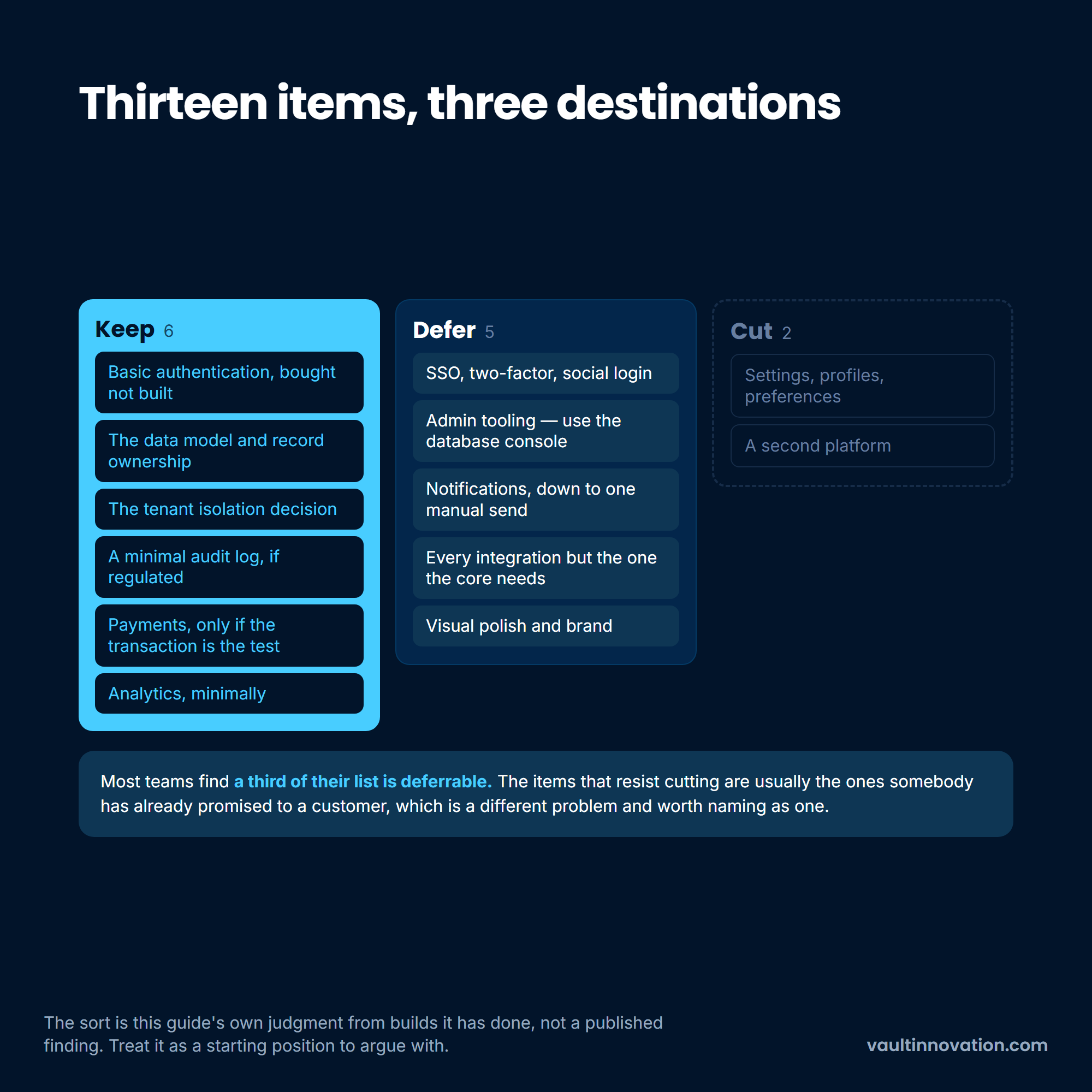
Write out every feature anyone has mentioned, including the ones that feel obviously necessary. Then sort each into keep, defer or cut using the table below, judging by whether it contributes to the evidence in step two and how expensive it is to add later.
Take the keep list to whoever is building it and ask what that costs. If it exceeds the budget, return to step three rather than negotiating the rate, because a cheaper team building the wrong scope is still the wrong scope.
Put them somewhere visible with the reason they were cut. A cut list that disappears gets re-litigated every two weeks, and a cut list that is written down becomes the roadmap if the test succeeds.
This is the artifact. The judgment column is ours, from the builds we have done, rather than a published finding. Treat it as a starting position to argue with, not a standard.
| Item | Judgment | Reason |
|---|---|---|
| Authentication, basic | Keep, and buy rather than build | Everything else depends on who the user is; identity services cost less than building it |
| SSO, two-factor, social login | Defer | Adds real work and changes nothing about the test |
| Data model and record ownership | Keep, and think hardest here | Changing it later means migrating live user data |
| Tenant isolation, if you serve businesses | Keep the decision, defer the sophistication | Cheap before the first customer's data exists, a rebuild afterward |
| Audit trail | Keep a minimal event log if regulated | Past events cannot be reconstructed once they have happened |
| Payments | Keep only if the transaction is the thing being tested | Otherwise invoice manually and find out if anyone pays |
| Admin tooling | Defer, use the database console | Only staff use it, and staff can tolerate friction |
| Settings, profiles, preferences | Cut | No effect on whether the core question is answered |
| Notifications and email | Defer to one manual send | Each channel is an integration with its own failure modes |
| Third-party integrations | Defer all but the one the core needs | The highest-variance line in any estimate |
| Analytics | Keep, minimally | You need to see whether the test worked |
| Visual polish and brand | Defer | A component library is enough to find out if people care |
| Second platform | Cut for now | Doubling the surface area doubles the maintenance |
Work down it honestly and most teams find a third of their list is deferrable. The ones that resist cutting are usually the features someone has already promised to a customer, which is a different problem and worth naming as one.
Six survive, five wait and two go.
Cutting is not the same as building cheaply. A short list built properly beats a long list built badly, which is the argument for giving the tech your idea deserves to the few things you keep.
The cut list works because things differ in how cheaply they can be added later, and that difference is predictable rather than mysterious.
Martin Fowler's case against speculative features sets the limit precisely. Presumptive features carry a cost to build, a cost of delay and a cost of carry, and the odds that any given one turns out unnecessary are high.
He is equally clear about the condition. Deferring only works if the code is easy to change, and there are times when it causes a problem and you face an expensive change that would have been much cheaper made earlier.
That condition is the whole rule. Defer what you can add without touching identity or data; keep what a migration would have to rewrite.
One question sorts the whole list, and it is not about effort.
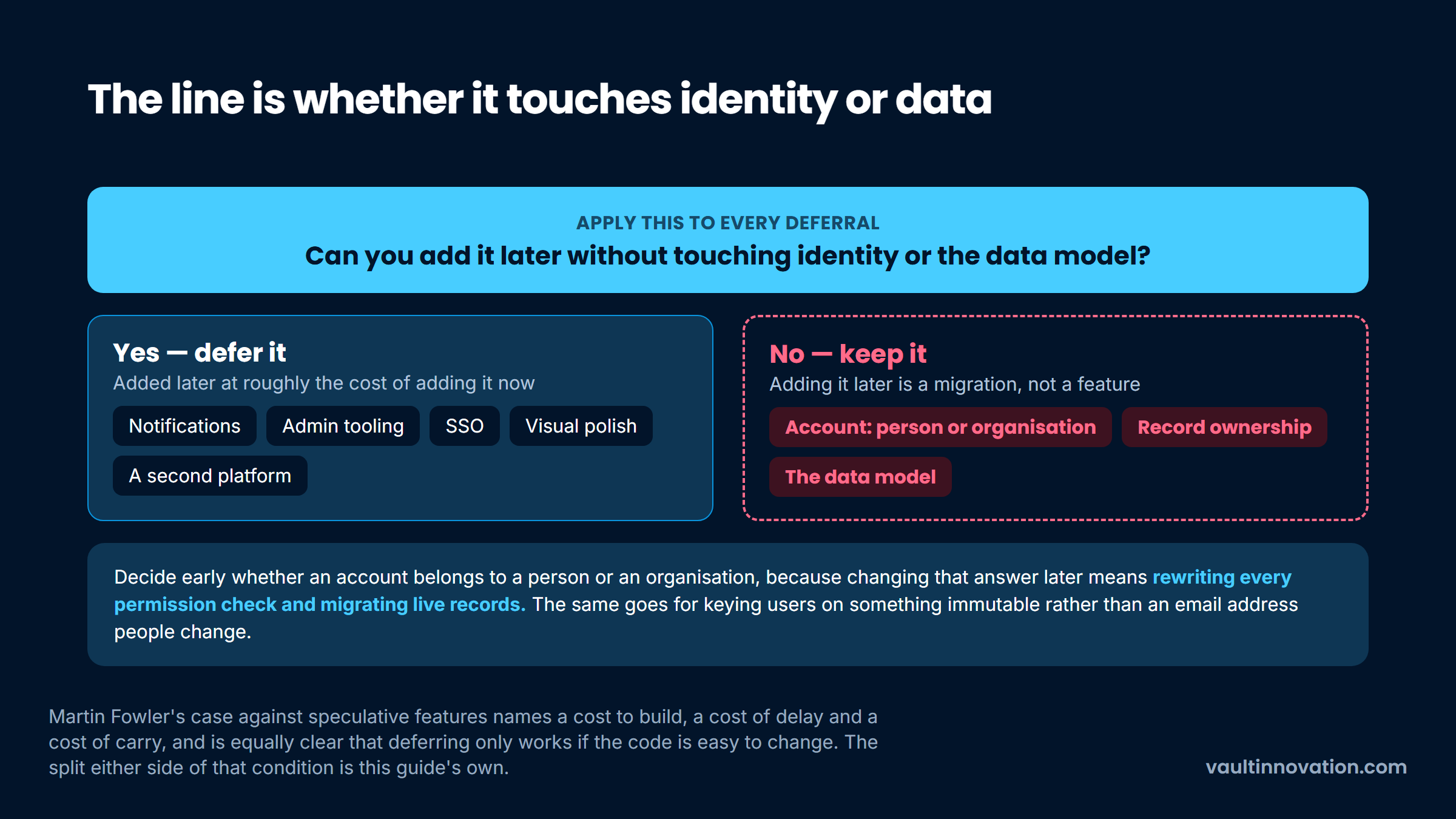
Identity is the clearest case. Decide early whether an account belongs to a person or an organization, because changing that answer later means rewriting every permission check and migrating live records. The same goes for keying users on something immutable rather than an email address people change.
Tenant isolation is the version that bites hardest. A freelancer on Reddit who rebuilds other people's MVPs described a product where three of eight beta users could see another user's data, with no tenant isolation in the design.
Their conclusion was that this is not a patch but a rebuild. That is one contractor's account, and it matches the architecture: isolation is a decision taken before the first customer exists, not a feature you bolt on afterward.
Three artifacts get conflated, they cost very different amounts, and each answers a different question.
| Artifact | Answers | Typically built with |
|---|---|---|
| Prototype | Would people understand and want this? | Clickable screens, no working backend |
| MVP | Will people actually do the thing? | Real software, one core flow, real users |
| First release | Can this run as a product? | Everything the MVP deferred, informed by what it learned |
The practical consequence is that a first release cannot be priced in advance, because its scope is whatever the MVP's findings say to build. Anyone quoting both together is quoting a guess for the second half.
The same logic explains why some MVPs grow rather than get replaced. On Leaf Trade the product we delivered was substantially larger than the original brief, because the discovery phase reshaped what the first version needed to be.
The company went on to raise $4.5 million. A scope that moves for that reason is the process working, not a plan failing.
Cutting is not free, and the failure mode at the other end is real: an MVP so thin that nobody can tell whether the idea works, which wastes the budget in a quieter way.
A founder on Reddit described the opposite error first, spending about four months on authentication, a dashboard, notifications, three integrations, onboarding and a settings page, then hearing from a bounced user that they could not work out what it did in the first 30 seconds. Stripping it back to the single core action, they report roughly 40 percent of users returning the following week. That is self-reported and anecdotal, and the shape of it is familiar.
The signal to watch is whether a cut removes work or removes the answer. Dropping the settings page removes work. Dropping the one screen where the user does the thing you are testing removes the answer, and then you have paid for a test you cannot read.
Two cuts are reliably false economies. Skipping the data model decision means a migration later. Skipping any way to observe what users do means running the experiment without instruments.
Our own design work usually starts here, with the question of what the first version has to prove, because that is the decision everything else inherits.
Write the question first, decide what evidence answers it, then build only what produces that evidence. The budget stops being a constraint you fight and becomes the thing that makes the prioritization honest.
Keep the cut list. It is the cheapest roadmap you will ever produce, and if the test works it is already prioritized by what you deliberately deferred.
Managed this way, MVP development cost stops being a number you receive and becomes one you decide, which is the only version of it you can act on.
If you have a number in mind and are not sure what it buys, contact us. We will tell you what we think is testable for it and which item on your list we would cut first.
Published ranges put a simple MVP anywhere from $500 to $25,000 and a complex one from $50,000 to $500,000, with each publisher defining the tiers differently. Those spreads describe scope, not rates.
A more useful answer comes from the other direction: decide the number you are willing to risk before you know the idea works, then cut scope until it fits. For an independent reference on project sizes, Clutch records a $25,000+ minimum and a $50,000 to $199,999 most common project size for our own profile.
Accounts, permissions and tenant isolation, which are the three things a SaaS product has that a single-user tool does not. Each one touches every screen, and all three are expensive to retrofit.
Everything else in a SaaS MVP, including billing, admin tooling and reporting, can usually be deferred or done by hand for the first cohort of customers.
Cut features that do not contribute to the evidence you need, defer anything addable later without touching identity or data, and buy rather than build commodity pieces like authentication.
What not to cut: the data model decision, tenant isolation if you serve businesses, and basic analytics. Those three cost more to add later than they do now.
Yes, provided you give each firm the same written question and the same keep list. Without that, you are not comparing quotes, you are comparing interpretations of a vague brief.
When two estimates land far apart on identical inputs, the gap is usually an assumption one of them made and the other did not. Ask which, rather than splitting the difference.
Build the smallest thing that produces a readable answer, and do the rest manually. Faking the parts a user cannot see, with a spreadsheet and a person behind it, is legitimate and routinely the fastest route to knowing whether the idea works.
The cheapest step of all happens before any code exists, and validating the idea first routinely changes what the MVP needs to contain.
A number is easier to spend well when somebody has said out loud what it cannot cover. Contact us and we will work through your list, tell you what we think is testable for your budget, and name what we would defer.