Blog
Key takeaways:
Someone asks for a proof of concept. Someone else builds a prototype. Two weeks later the review goes badly, because one person wanted to know whether the integration was possible and the other brought a clickable screen flow that proves nothing about the integration.
That confusion costs real money, and it is avoidable. The two artifacts answer different questions, take different skills to build, and fail in different ways.
This guide draws the proof of concept vs prototype line where it actually sits, using the definitions engineers have used since long before software blogs adopted the terms. It also covers where the boundary genuinely blurs, what changes when the concept involves AI, whether you should pay a vendor for one, and the failure mode that hurts most teams far more than choosing the wrong artifact.
If you only want the short version: a proof of concept asks whether something can work, and a prototype asks how it should work.
A proof of concept exists to answer a single question with a yes or a no. Can this thing work?
Not "will users like it," not "will it sell," and not "what should it look like." Just whether the technical or commercial idea holds up when someone tries it. If the answer is no, you have saved the cost of the whole build, and that is the entire return on the exercise.
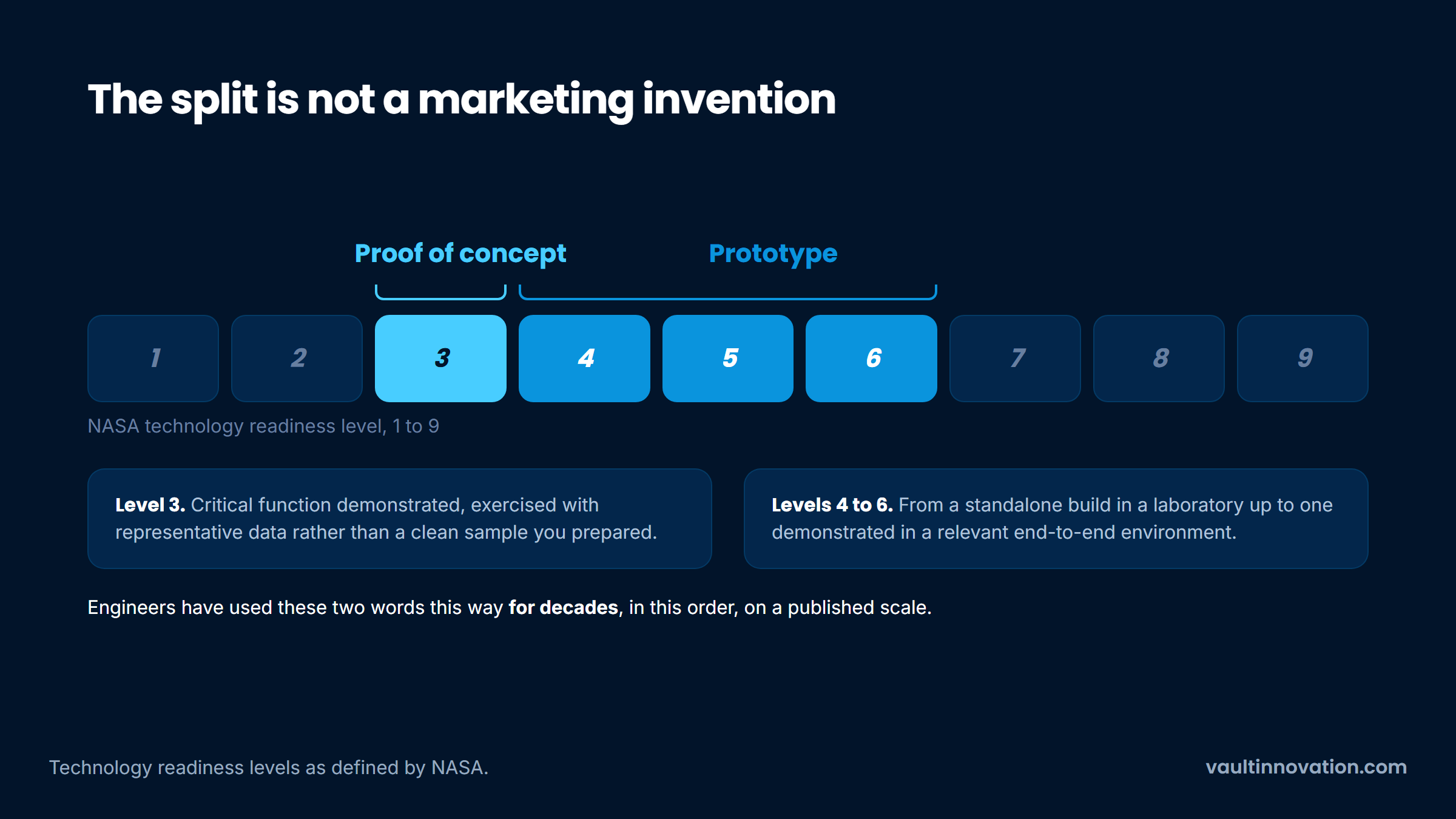
The term is older than the software industry's use of it. NASA's technology readiness levels define level 3 as "analytical and experimental critical function and/or characteristic proof-of-concept," reached through "demonstration of technical feasibility using breadboard or brassboard implementations that are exercised with representative data."
Strip the aerospace vocabulary and that is a precise description of what a good software proof of concept does. You isolate the one function everything else depends on, you run it against data that resembles the real thing, and you find out.
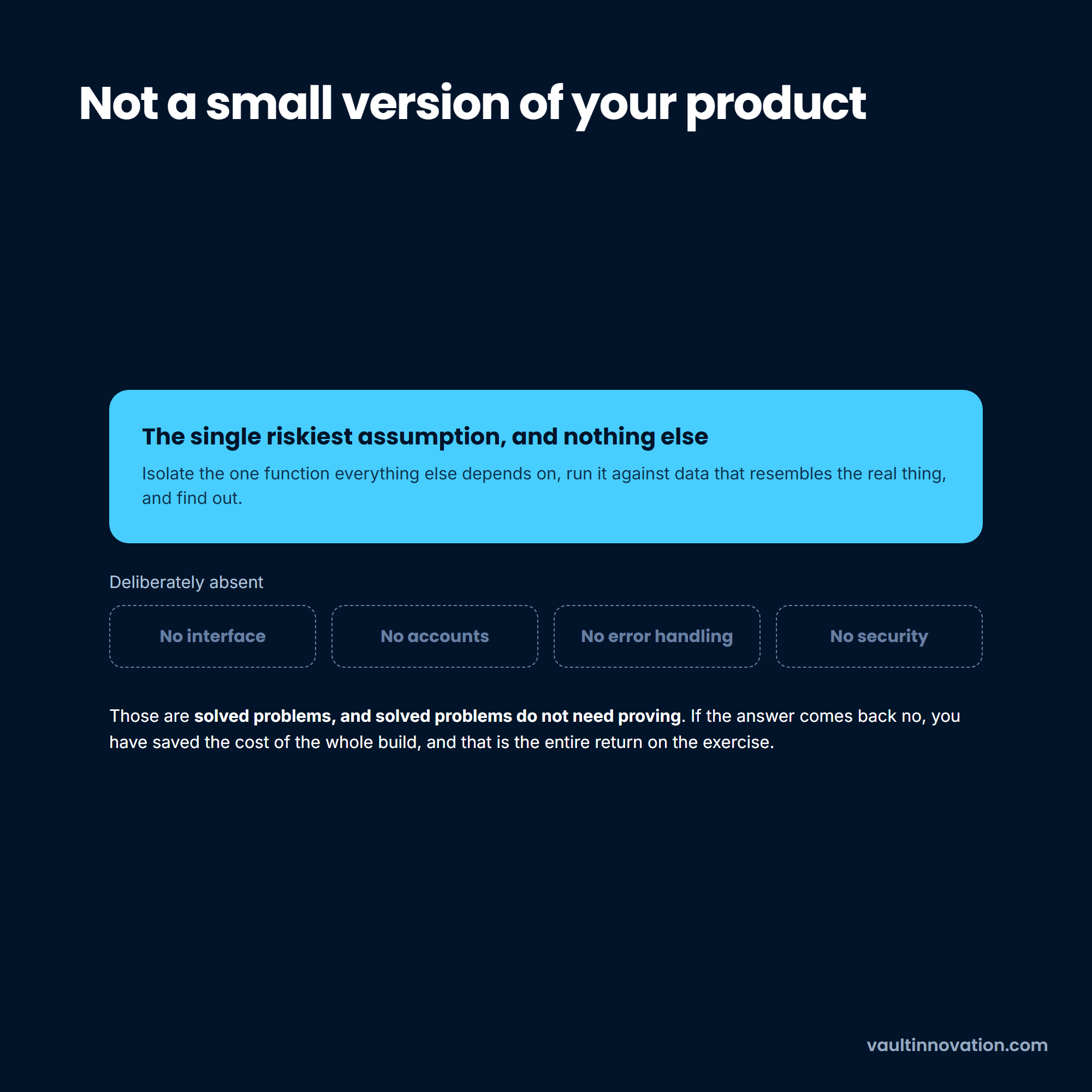
That word "critical" is doing the work. A proof of concept is not a small version of your product. It targets the single riskiest assumption, which means most of your product is deliberately absent. No interface, no accounts, no error handling, no security. Those are solved problems, and solved problems do not need proving.
Laid out, a proof of concept is mostly the things you have chosen not to build.
The practical consequence is that a proof of concept is usually ugly and almost always internal. Nobody outside the team should see it, because it will give them entirely the wrong impression of how finished the idea is.
A prototype assumes the thing can be built and asks a different question: how should it behave for the person using it?
That means a prototype has to be seen by people outside the team, which is the clearest practical difference between the two. A proof of concept that nobody outside engineering ever looks at has still done its job. A prototype nobody outside the team looks at has done nothing at all.
Prototypes vary enormously in how finished they are, and the useful framing comes from Nielsen Norman Group, which points out that fidelity is not one dial. It varies independently across interactivity, visuals, and content. A prototype can carry final copy on rough wireframes, or beautiful screens filled with placeholder text, and those two choices test completely different things.
That framing matters because "high fidelity" gets used as a synonym for "better," and it is not. If you are testing whether people understand your terminology, real content on ugly screens beats polished screens full of lorem ipsum every time.
NASA's scale puts prototypes at levels 4 through 7, after proof of concept. They run from "standalone prototyping implementation and test" in a laboratory, through one demonstrated "in a relevant end-to-end environment" at level 6, up to "system prototyping demonstration in an operational environment" at level 7.
Level 8 is where it stops being a prototype at all and becomes an actual system, mission qualified. The progression is the same one software teams follow, described more carefully.
On the full scale, the two words sit in different places and always have.
Our own most useful prototype did a job most teams never plan for. When we built the Nimbus platform for iCopy Legal, a medical records retrieval company, our design team produced a clickable prototype that became a foundation for development and a sales asset at the same time. iCopy pre-sold the new service model using that prototype, before the platform existed. Client volume later rose 300% and revenue grew tenfold within two years.
The differences are easiest to hold onto in one view, so here is the comparison that matters when you are deciding which to commission.
| Proof of concept | Prototype | |
|---|---|---|
| Question it answers | Can this be built? | How should this work? |
| Who sees it | The team, and sometimes an investor | Users, stakeholders, buyers |
| What exists at the end | Evidence, often a script or a test result | A representation people can move through |
| Interface | Usually none | The entire point |
| Built by | Engineers | Designers, sometimes with engineers |
| What a "no" means | Stop, or change the approach | Change the design, not the idea |
| Typical duration | Days to about two weeks | One to four weeks |
| Reused in the build? | Rarely, and it should not be | Often, as the design reference |
The last row is the one teams underestimate. A prototype is meant to survive into the build as a reference. Proof of concept code is meant to be thrown away, and the trouble starts when it is not.
The taxonomy is usually presented as settled. It is not, and treating it that way sets you up to be surprised in a meeting.
The fault line runs through one question: can a prototype be functional? Some teams treat a prototype as strictly a representation, a shape with nothing behind it. Others distinguish functional from non-functional prototypes and consider a working, clickable build with a real backend to be a high-fidelity prototype. Both usages are common and both are defensible.
You can watch the disagreement happen in public. In one r/startups thread, the well-received answers describe a proof of concept as showing that the key piece works and a prototype as showing that the pieces work together, while another commenter inverts the order completely and defines a proof of concept as the stage where customers are paying. That is anecdotal, and it is exactly the confusion you should expect around a conference table.
Labels aside, both artifacts get judged on what people say when they meet them, and what people say is reliably different from what they do, a gap we have written about in user interviews.
The prototype vs proof of concept argument is not worth winning. It is worth defusing, and the way to defuse it takes one sentence at the start of the engagement: agree on the question the artifact has to answer, and write it down. Nobody argues about labels once the question is explicit, because the question determines what gets built.
That is the practical resolution to the whole proof of concept vs prototype debate. Treat the two words as shorthand for two questions rather than two deliverables, and the disagreement stops mattering.
Two more terms crowd this space, and one of them is a genuine mess.
An MVP is the smallest version you can put in front of paying customers and learn from. It is a real product with real users, which puts it a long way past both artifacts above. A proof of concept vs MVP comparison is really a comparison between an experiment and a product.
"Pilot" is where the vocabulary breaks down, because there is no agreed definition at all. In practice the word gets used for a private beta, for a one-time walkthrough with a single client, and as a straight synonym for proof of concept. Ask ten people in one organization to define it and you can get ten answers, which is why writing down what you mean beats arguing about which word is correct.
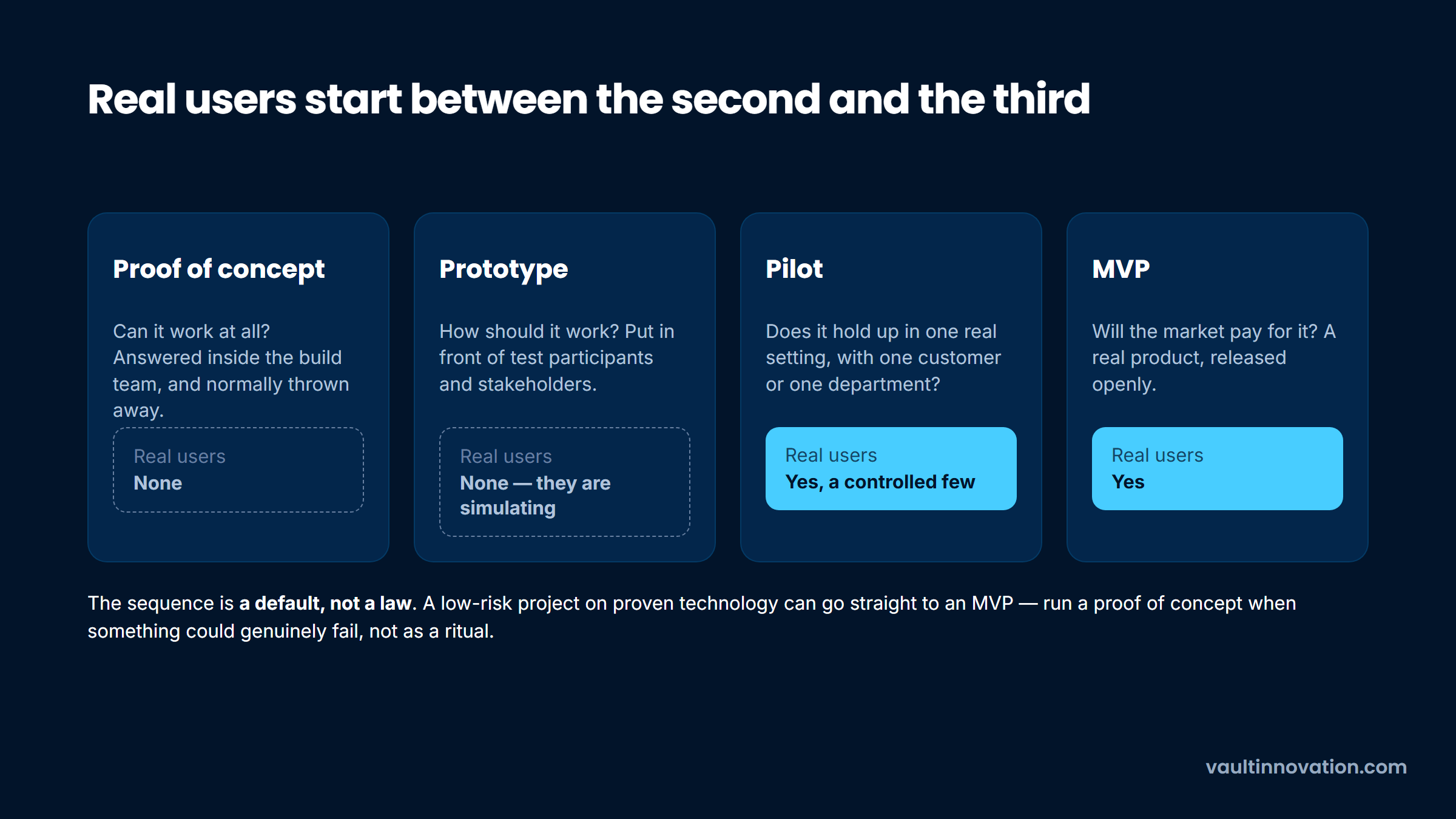
Treating a proof of concept vs prototype vs pilot question as a vocabulary problem rather than a process problem saves a lot of time. Here is the map we use.
| Stage | Question | Who uses it | Does it have real users? |
|---|---|---|---|
| Proof of concept | Can it work? | The build team | No |
| Prototype | How should it work? | Test participants, stakeholders | No, they are simulating |
| Pilot | Does it hold up in one real setting? | One customer or one department | Yes, a controlled few |
| MVP | Will the market pay for it? | Real customers, openly | Yes |
The proof of concept vs prototype vs MVP sequence is a default, not a law. Some practitioners argue the feasibility stage is skippable more often than not, and Steve Blank makes that case with a worked example: a drone-imaging startup was about to spend its time proving it could fly a camera and stitch the images together, when camera-equipped drones were already a solved problem and the genuinely untested assumption was whether farmers would pay for the data.
His verdict was that the team had defined the wrong thing to test first. Run a proof of concept when something could genuinely fail, not as a ritual.
The four stages divide cleanly on one question: whether anybody real is using it.
The opposite error is more common than skipping a stage, and it is overthinking the plan until nothing gets tested at all.
Most proof of concept development fails quietly, by producing a demo everyone admires and nobody can interpret. The fix is to decide what counts as failure before you start, which is the one habit that separates useful proof of concept development from an expensive demonstration.
The sequence below is short on purpose, because every step you add is a step that invites scope back in.
Step two is where most teams skip ahead, and it is the one that makes the whole exercise falsifiable. "The matching logic works" is not a threshold. "The matcher resolves at least 90% of records without human review" is, and it turns the final meeting into arithmetic instead of opinion.
Step five is where results go wrong in a way nobody notices until much later. Clean sample data hides exactly the problems a proof of concept exists to surface, which is why NASA's own definition specifies "representative data" rather than any data. Real records are inconsistent, incomplete, and full of formats nobody documented. That is the point, and a problem worth solving usually looks messiest at exactly this stage.
Time-boxing is not a productivity habit here, it is a safeguard. A proof of concept with no end date becomes a small unfunded product, and the team keeps polishing it because stopping feels like failing.
An AI proof of concept looks like the others and behaves differently, because the thing that usually fails is not the code.
With conventional software, feasibility is mostly a question of whether the integration exists and the performance holds. With a model, the code is frequently the easy part. What decides the outcome is whether you have data of sufficient quality and volume, and whether the output is right often enough to be worth acting on.
That changes what you build first. Before any interface and often before any model work, you need a labeled evaluation set: a batch of real examples where you already know the correct answer, so you can measure accuracy rather than admire outputs. Teams that skip this end up with a demo that impresses everyone and a system nobody can score.
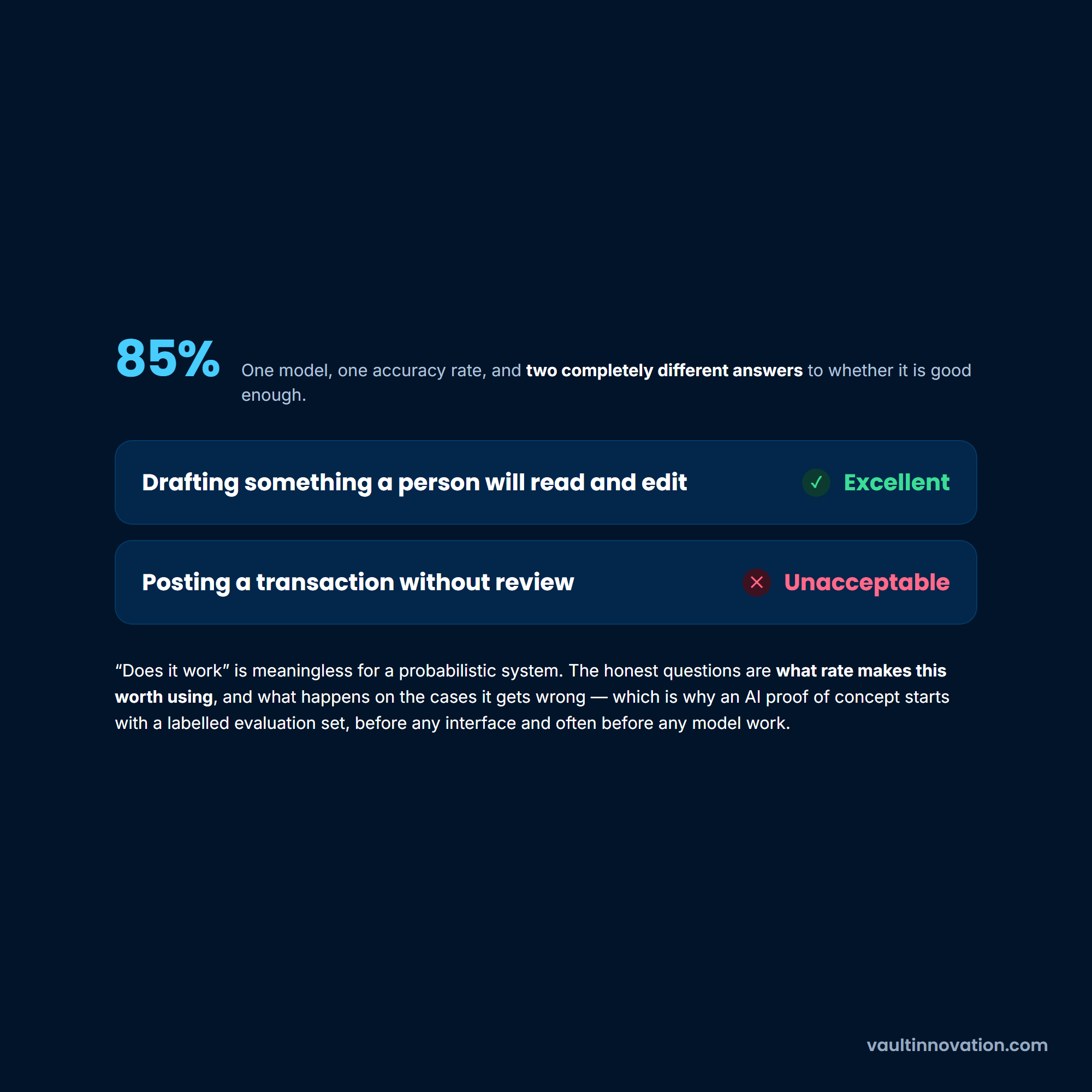
The threshold conversation changes too. "Does it work" is meaningless for a probabilistic system. The honest question is what accuracy rate makes this worth using, and what happens on the cases it gets wrong. A model at 85% is excellent for drafting and unacceptable for anything that posts a transaction without review.
The same accuracy is a pass and a fail depending only on what it feeds.
There is a technique worth knowing here, and Nielsen Norman Group describes it well: the Wizard of Oz test, where a person quietly performs the task behind the interface to simulate functionality that does not exist yet. It is particularly useful for AI systems, because you can test whether the output is even valuable to someone before you spend a quarter building the thing that produces it.
Running the task by hand behind a mock interface is also the cheapest way of letting users guide you while the model is still hypothetical.
This failure mode damages more teams than picking the wrong artifact ever has.
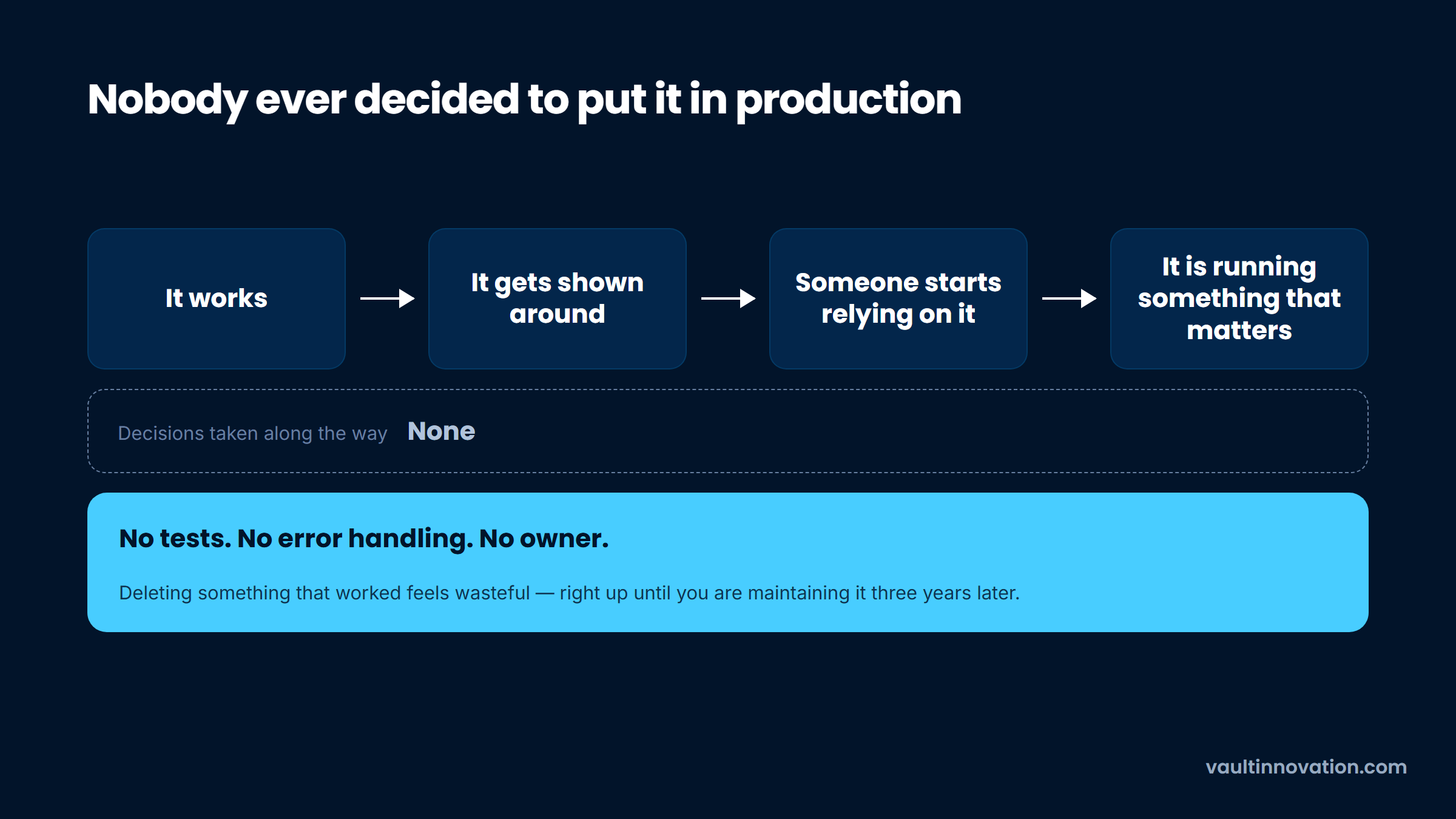
A proof of concept works. It gets shown around. Someone starts relying on it. Nobody ever decides to promote it to production, and yet there it is, running something that matters, with no tests, no error handling and no owner.
Read as a sequence, there is no point at which anyone chose this.
The pattern is common enough to be a running joke among the people who maintain systems. In one r/sysadmin thread, an administrator describes standing up a tool "for evaluation" and finding developers depending on it within a couple of months, with the most upvoted reply asking whether anyone has proofs of concept that do not end up in production. It is anecdotal, and it will be familiar to anyone who has run one.
Three safeguards actually work, and they all work by making the thing unpleasant to adopt:
That last one sounds bureaucratic and is the one that matters most, because a successful proof of concept creates real pressure to keep going. Deleting something that worked feels wasteful, right up until you are maintaining it three years later.
This question comes up constantly between buyers and vendors, and almost nobody writing about proof of concept software development will touch it, probably because the people writing are usually the vendors.
Our answer is that a proof of concept is real engineering work and should be paid, and that you should be suspicious of anyone who offers one free. A free proof of concept is either trivial enough to prove nothing, or it is sales expense the vendor recovers somewhere less visible in the engagement.
What you should expect in return is a written question, a threshold, a fixed budget and a date. If a vendor cannot tell you what result would make them recommend against the project, they are not running an experiment.
Cost tracks the risk being tested rather than the size of the eventual product. Clutch reports our own minimum project size at $10,000 and an average rate of $150 to $199 per hour, which gives a sense of the band for this kind of scoped work, though every proof of concept is quoted against its specific question. Beware published proof of concept price ranges: they are one firm's rate card, not an industry benchmark.
Scoping the question well is most of the value, which is why we treat it as product strategy work rather than a preliminary to it.
The decision takes about a minute if you ask the questions in the right order.
Start with whether anything could actually fail. If some part of your idea depends on an integration nobody has confirmed, a data source of unknown quality, or a model that may not be accurate enough, you need a proof of concept and you need it before design work starts.
If the technology is settled and your real uncertainty is whether people will understand the thing, you need a prototype. Most internal tools, most marketplaces and most straightforward web applications land here, and running a proof of concept for them is theater.
If both are genuinely uncertain, run them in that order and keep them small, because a prototype built on an idea that turns out to be infeasible is wasted work no matter how good the design was. Where the uncertainty is really about demand rather than feasibility or usability, neither artifact is the answer and you should be validating the idea directly instead.
The failure we see most often is not choosing wrong. Teams choose nothing, build for four months, and meet the hard problem in week fourteen, when changing course costs a great deal more than it would have in week two.
In software development, a proof of concept is a small, deliberately incomplete build whose only job is to establish whether a specific technical or commercial idea is viable. It targets the riskiest assumption in a project and ignores everything else, which is why it usually has no interface, no user accounts and no error handling.
The output is evidence rather than software, which is the part people find counterintuitive. A proof of concept that produces a clear no has succeeded, because it did so before the budget was committed.
The strongest ones isolate a single dependency. Testing whether two systems can exchange records at the volume and format you actually have is a proof of concept. So is running a matching algorithm against real historical data to see what share it resolves without a human, or checking whether a device can capture a reading accurately enough to be worth building an app around.
Weak proof of concept examples tend to be small versions of the whole product, which prove that you can build software you already knew you could build.
A proof of concept is an experiment run inside the team to answer a feasibility question, and it is normally thrown away. An MVP is a real product, released to real customers, that you intend to keep and improve.
They also fail differently. A failed proof of concept tells you the approach is wrong and saves you the build. A failed MVP tells you the market does not want what you made, which is a more expensive lesson learned later.
Days to about two weeks is the normal band, and the limit should be set before work starts rather than discovered afterwards. The scope is one question, so a proof of concept that runs a month is usually answering several questions or quietly turning into a product.
If the question genuinely cannot be answered in two weeks, that is worth knowing on its own. It usually means the risk is larger than anyone had assumed and deserves a proper discovery phase.
Often, yes. If your project uses technology that is well established and your uncertainty is about design, flow or comprehension, a proof of concept adds delay without reducing risk.
Skip it when nothing could fail technically. Run it when something could, and be honest about which situation you are in, because the temptation to declare the risky part "probably fine" is strong and expensive. The order of the two only matters when the feasibility question is real.
If you are not sure whether your next step is a feasibility test or a design test, that ambiguity is usually a sign the riskiest assumption has not been named yet. That is a short conversation, not a project.
Contact us and we will help you work out which question is worth answering first.