Blog
Key takeaways:
A legacy modernization strategy is mostly a sequencing problem wearing the costume of a technology problem. The hard questions are which part to move first, how to keep the business running while you move it, and how you will know when the old system can finally be switched off.
Most guides answer a different question. Write-ups of legacy system modernization strategies list the approaches, each one starting with the letter R, and leave you to work out which applies. That list is useful and it is the easy part.
This guide spends its time on the choosing and the sequencing, using the clearest public evidence available on what separates a modernization plan that works from one that stalls.
Legacy modernization is the work of updating a system that still runs the business but can no longer change at the speed the business needs. The important word is still. A system nobody uses is a decommissioning job, which is far easier.
Age alone does not make something legacy. The usable definition is a system where the cost of each new change is rising, the people who understand it are leaving, and the risk of touching it has started to shape what the business is willing to attempt.
That last symptom is the one worth watching. When a team begins designing around a system rather than through it, the system has started setting strategy, and nobody decided that.
The decision is also not binary. Plenty of organizations get more value from improving what they have than from building new, which is the honest version of the choice between breaking new ground or optimizing what already works.
The best public evidence on this comes from the federal government, because its systems are audited and the findings are published. In 2019 the Government Accountability Office identified the ten federal IT systems most in need of modernization, then followed up on them.
Its 2023 report gives the figures, as the agencies reported them in 2019. Those ten systems ranged from about 8 to 51 years old and collectively cost around $337 million a year to operate and maintain. Several ran on older languages such as COBOL, several were operating with known security vulnerabilities, and several depended on unsupported hardware and software.
The GAO is specific about what relying on those languages costs: rising procurement and operating expenses, and a shrinking pool of people with the right skills. That second one compounds quietly, because it is not a line item until the week somebody retires.
Note what the $337 million buys. It is not improvement, it is continuation. That is the number to put next to a modernization estimate, because the comparison is never new spending against zero, it is new spending against an operating cost you are already paying with nothing to show for it.
You do not need a decades-old federal system for this to apply. A five-year-old app built quickly for an early market, with its original developers gone and every release a little riskier than the last, shows the same symptoms at a smaller scale. The comparison is the same too: what it costs to keep running as it is, against what it costs to change.
Picking a legacy modernization approach before assessing the system is the most common way these projects go wrong, because the approaches are not interchangeable and the right one depends on facts you do not have yet.
An assessment needs to produce two independent judgments per component: how much the business depends on it, and how healthy it is technically. Those are different axes, and the combination tells you what to do. High business value with poor technical health is where modernization pays. Low value with poor health is a candidate for retirement, which is cheaper than any rewrite.
The dependency map is the one that changes plans. At VAULT we have yet to assess a system where the list of things that talk to it was complete at the start, and the undocumented integration is what turns a clean cutover into an incident.
If your intention is to put AI on top of the modernized system, the assessment also needs to cover whether the data is in a usable state, which is a separate question from whether the code is, and the one an AI readiness assessment exists to answer.
Every legacy modernization strategy eventually resolves into a choice per component, and the standard list of options is usually presented as a set of Rs. The useful way to read it is by what actually changes, because that determines both the cost and the benefit you can honestly expect.
| Approach | What changes | What does not | Buys you |
|---|---|---|---|
| Retain | Nothing, by decision | Everything | Time, and a documented reason for the delay |
| Retire | The system is switched off | Nothing else | Removal of run cost and risk, at the lowest development cost |
| Rehost | Where it runs | The code and architecture | Exit from aging hardware or a data center |
| Replatform | The runtime, database version or OS | The application's structure | Supported dependencies and some operational gain |
| Refactor | Internal code structure | External behavior and architecture | Changeability, lower cost per future change |
| Rearchitect | How the system is decomposed | Most business logic | Independent deployment, scaling, team ownership |
| Rebuild | The implementation, from scratch | The requirements, in theory | A clean system, at the highest risk and cost |
| Replace | The whole thing, with a bought product | Your process, which must adapt | Someone else maintaining it |
Rehosting is the legacy modernization approach most often oversold. Moving an application to a cloud provider without changing it removes a hardware problem and leaves the changeability problem exactly where it was, and it can increase run cost.
Retire deserves more attention than it gets, since it carries the lowest development cost of any row. Our development team has more than once found that the clearest win in an assessment was two components nobody had used in three years.
Rebuild is the instinct, and it is worth understanding why experienced practitioners argue against it. Martin Fowler, who gave the strangler fig pattern its name, describes the appeal precisely: we know what the old system does, so we build a new one that does the same thing in better technology.
His assessment of how that goes is unusually direct. In his write-up of the strangler fig application, he says such plans have mostly gone down in flames, and gives three reasons worth separating.
Replacing a serious system takes a long time, and users cannot wait that long for new features. Replacements look easy to specify, and the details of existing behavior turn out to be hard to establish. And much of that behavior is not actually wanted, so building it again is waste.
The third reason is the one that reframes the project. A rebuild that faithfully reproduces the old system has spent its entire budget recreating decisions nobody would make today, including the ones that are the reason you are modernizing.
A developer on r/Backend described the same tension from inside it: the thought that starting fresh would be easier keeps returning, and the obstacle is that the existing system already works and carries years of edge cases, integrations, reporting and revenue. Another commenter noted that every team they had joined in a decade had a next-generation project underway.
The alternative is to grow the new system around the old one and move behavior across in pieces, which is where the strangler fig metaphor comes from. A vine germinates in a host tree, grows until it can sustain itself, and the host eventually dies leaving the fig in its shape.
Fowler points to four high-level activities defined by Ian Cartwright, Rob Horn and James Lewis, and notes the order does not imply a sequence. Understand the outcomes you want. Decide how to break the problem into smaller parts. Deliver those parts successfully. Change the organization so this can keep happening.
The first is the one teams skip and the one that sinks projects. Fowler's observation is that objectives are often muddled, with different groups wanting different things, so alignment has to be established early and revisited.
The second activity is the real engineering work. Well-designed systems have clear components you can replace independently, and legacy systems rarely do, so you have to find or create the seams where the system can be split. Fowler's footnote on this is worth keeping: in a well-designed system those seams would already exist, but such systems are unicorns.
Running old and new side by side also means you need a way to tell when their behavior diverges, which is a verification problem rather than a migration one, and it belongs in the quality assurance process rather than in the migration plan.
The strangler fig pattern tells you to replace in pieces. It does not tell you how the pieces talk to what remains, and that gap is where a careful incremental plan still produces a mess.
The missing part is an anti-corruption layer, a pattern Eric Evans first described in Domain-Driven Design. Microsoft's architecture guidance on the pattern describes it as a facade or adapter layer that translates requests between subsystems that don't share the same semantics, so that dependencies on the old system don't limit the new one's design, and it names gradual migrations as the case where it matters most.
The same guidance is explicit about the risk. When legacy features have quality problems, supporting them "corrupts what might otherwise be a cleanly designed modern application." Left unchecked, that is how a modernization ends up as a distributed monolith rather than a modernized system.
That is the failure worth naming, because it looks like success for about a year. The services are separate, the deployments are independent, and every one of them still speaks the old system's data model, so no service can change without the others. You have paid for distribution and kept the coupling.
The practical implication is that the translation layer is part of the first increment, not a later cleanup. If the new component reads the legacy schema directly because it is faster to ship, the anti-corruption layer will never be built.
The first increment is chosen to prove the mechanism, because everything after it depends on the mechanism working. Value comes second here, though it is the tie-breaker between candidates that are equally good proofs.
Step seven is where strategies quietly fail. An old path left in place because removing it feels risky becomes permanent, and then the system has two ways of doing everything and you have added complexity rather than removed it.
Working out which component to start with is genuinely hard from inside a system you built, and it is the sort of thing worth an outside read.
Data is usually the part that determines the schedule, because the code can be rewritten in isolation and the data has to move exactly once, correctly, while the business keeps using it.
The approach that works is to treat the migration as a repeatable, verifiable transformation rather than a one-time event. Write it as code, run it against a copy of production as often as you need to, and build the comparison that proves the output matches before any cutover depends on it.
Parallel running is the safety net: both systems process the same inputs, and you compare results until the differences are either zero or explained. Every difference is either a migration bug or an undocumented behavior of the old system, and both are worth finding before a customer does.
Both answers are worth having, which is what makes the comparison worth running.

Our work on the Nationwide Transfer data mapping project was a pure version of this problem, transforming 28 million records from source data into usable leads. At that volume the transformation has to be deterministic and re-runnable, because nobody is reconciling 28 million rows by hand, and the full write-up of the data mapping project covers how it was built.
Here is the most useful thing in this guide, and it comes from an auditor rather than an architect. The GAO assesses whether a modernization plan is complete against three elements: milestones to complete the modernization, a description of the work necessary to modernize the system, and details regarding the disposition of the legacy system.
Three plain requirements, and a more demanding legacy modernization framework than most vendor checklists. Now look at how the ten most critical federal systems scored on them in the 2019 review, counting only the seven agencies that had a documented plan at all.
| Plan element | Fully met | Partially met | Not met |
|---|---|---|---|
| Milestones to complete the modernization | 3 | 3 | 1 |
| Description of the work necessary | 4 | 2 | 1 |
| Disposition of the legacy system | 3 | 0 | 4 |
Only the Departments of Defense and the Interior met all three. Three further agencies, Education, Health and Human Services, and Transportation, had no documented modernization plan for a system their own agency rated as high criticality.
Counted out across the seven plans, one row behaves unlike the other two.
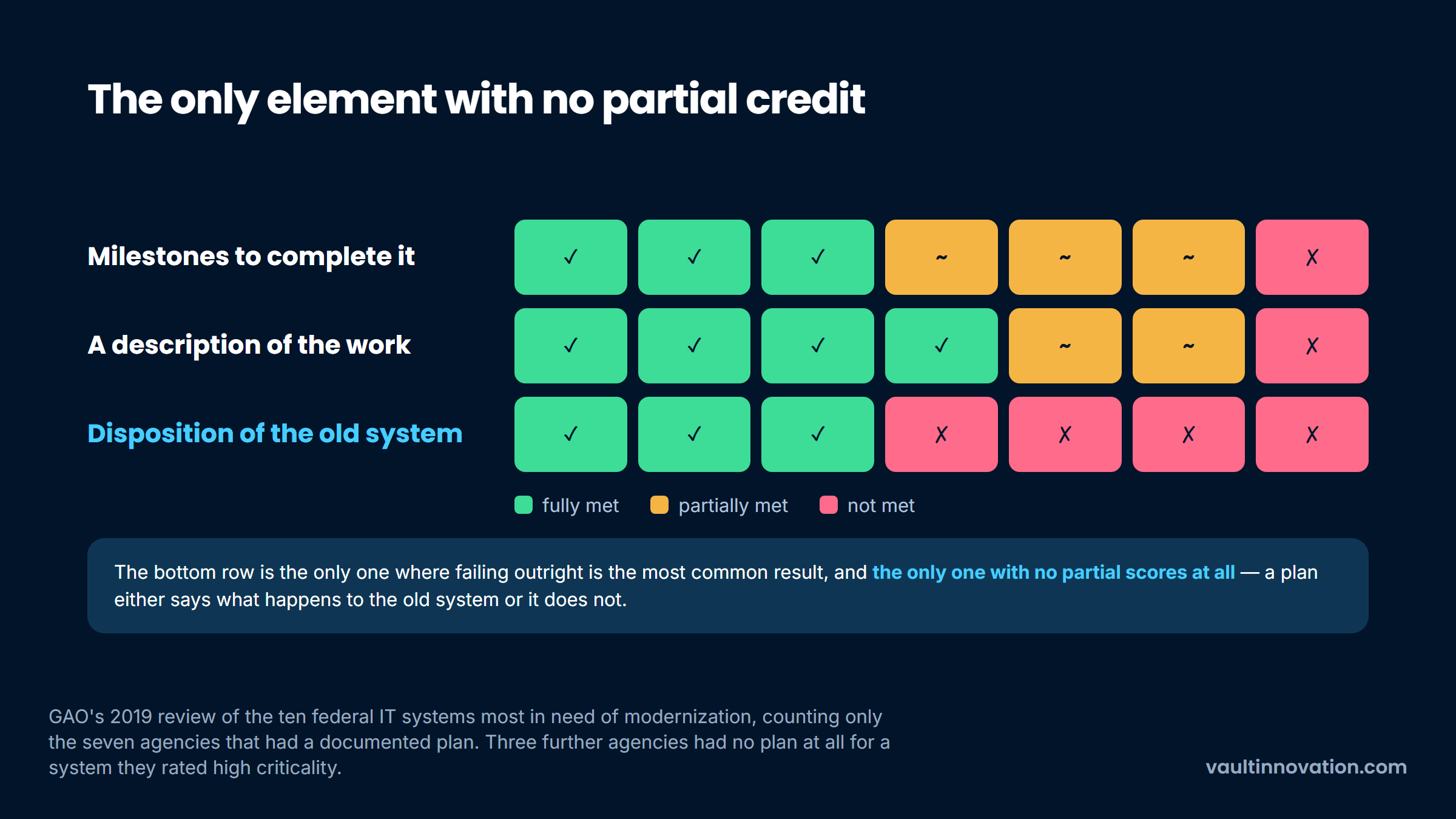
The disposition row is the one to sit with. It is the only element where failing outright was the most common result, and it has no partial scores, because a plan either says what happens to the old system or it does not.
That omission explains a pattern anyone who has worked on these projects will recognize: the new system launches, the old one stays on, and the organization now funds both.
So write the disposition down as explicitly as the build. Name the date the legacy system stops accepting writes, who signs off that nothing still depends on it, where its data goes for retention, and which contracts end when it does.
The same thinking applies whenever a system changes hands, which is why transitioning a project between teams works better as a planned handover than an event.
The GAO's July 2025 follow-up shows how long the work itself takes. As of February 2025, nearly six years after the original findings, agencies had completed three of the ten modernizations. Of the seven still running, four were planned to finish in the next few years, two in five or more years, and one had no planned completion date at all.
The same report reviewed eleven newly identified critical systems, and only three of them had a plan with all three elements. Writing the plan is not the hard part, and it is still the part most often left undone.
Modernization needs two kinds of knowledge at once: deep familiarity with a system nobody documented, and current experience with whatever you are moving to. Most organizations have the first and not the second, and the people with the first are also the ones keeping the existing system running.
That constraint shapes the staffing more than the budget does. Pulling your most knowledgeable engineer onto the new system is how the old one starts to fail during the migration, and leaving them on the old one is how the new system reproduces decisions nobody questioned.
The arrangement that tends to work is to keep institutional knowledge on the assessment and the seam-finding, where it is irreplaceable, and bring in additional capacity for the build. We take on this kind of work for startups and growing companies, usually as an engineering team working alongside the people who know the system, and the tradeoffs of outsourcing software development matter more here than on a greenfield build because the handover goes both ways.
Every legacy modernization strategy should start with the assessment, and give it a deadline so it does not become the project. Two weeks of inventory, dependency mapping and run-cost arithmetic will tell you more about sequencing than a month of architecture diagrams.
Write the plan against the GAO's three elements next, including the disposition of the old system, before any code is written. If you cannot say what happens to the legacy system, you do not yet have a legacy modernization strategy, you have a parallel-systems strategy with a different name.
Pick the first slice to prove the mechanism, build the anti-corruption layer with it, and switch the old path off before starting the second. Choosing who helps you do it matters as much as the sequence. A firm that has run a modernization answers questions about seams and cutover differently from one that has only read about it, which is the distinction worth probing when choosing a development company.
It is the plan for a system the business depends on and can no longer change quickly enough. The plan has to say which components get touched, which approach applies to each, what order they go in, and how the old system eventually stops running.
The GAO treats such a plan as complete only when it has milestones, a description of the work necessary, and the disposition of the legacy system.
Legacy application modernization strategies are usually grouped as retain, retire, rehost, replatform, refactor, rearchitect, rebuild and replace. What separates them is what actually changes: rehosting moves where a system runs without touching the code, refactoring changes internal structure while preserving behavior, and rebuilding starts over. Retire is the most overlooked of these legacy system modernization strategies, because it removes run cost and risk with the least development work.
Usually not. Martin Fowler's own write-up reports that wholesale replacements mostly go down in flames, for three reasons: they take too long for users who need new features, the existing behavior turns out to be hard to specify, and much of that behavior is not wanted anyway. Incremental replacement behind a translation layer carries far less risk, though a rebuild can be right for a small system with few integrations.
It should include the assessment output, a chosen approach per component with the reasoning, the order of increments with milestones, the anti-corruption layer for each boundary, the data migration and verification method, and the decommissioning plan for the old system. Give every increment a definition of done that includes removing the old code path, since a legacy modernization roadmap that only adds things leaves you running two systems.
Long enough that you should plan to deliver value during it rather than at the end, which is the main argument for the incremental approach.
For scale, the GAO reported in 2025 that agencies had completed only three of the ten critical federal modernizations it flagged in 2019, and one of the remaining seven still had no planned completion date. Sequencing by business value means the first slice can ship in weeks even when the full program runs for years.
The hardest part of this work is usually not the technology. It is deciding which piece to move first and being able to say, at the end, that the old system is genuinely switched off.
If you are weighing up what to do with a system that still works but costs you speed, contact us. Two weeks of assessment is usually enough to say whether the answer is modernize, replace or retire.