
Blog
Key takeaways:
You do not need a consultant to find out whether your company is ready for AI. You need about ten minutes, an honest answer to six questions, and the willingness to score yourself lower than you would like.
Most AI readiness assessments you will find online are lead-capture forms. You answer twenty questions, you receive a grade, and the grade is always "promising, but you should book a call." This one is a worksheet you run yourself, on paper if you want, and nobody sees the result but you.
Below is what readiness actually measures, the six dimensions that decide it, the scoring instrument, a worked example, and what to do with whatever number you end up with.
An AI readiness assessment is a structured check of whether your organization can get value from AI, run before you commit budget to a specific project. It measures the conditions around the technology rather than the technology itself.
That framing matters because the failure mode is so consistent. Companies do not usually fail at AI because they chose the wrong model. They fail because the data the model needed was scattered across four systems with no agreed owner, or because the people whose workflow was supposed to change never changed it.
Our own view, from building AI features into client systems, is that most pilots die on data readiness and adoption rather than on model quality. That is not a controversial position among people who have shipped this work, and it is why the worksheet below spends four of its six dimensions on things that have nothing to do with machine learning.
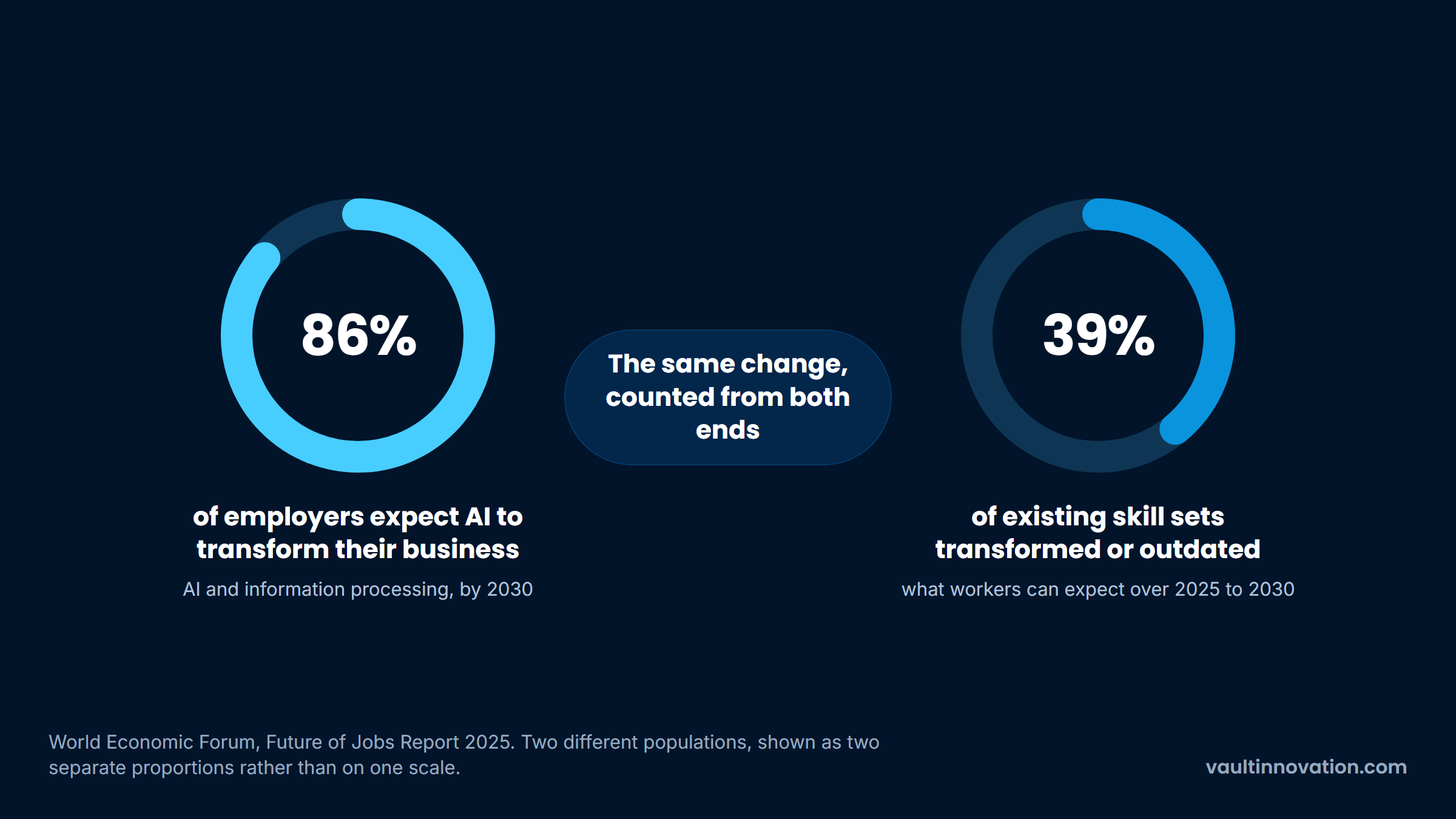
The gap between interest and delivery is wide and well documented. The World Economic Forum's Future of Jobs Report found that 86% of employers expect AI and information processing to transform their business by 2030, and that workers can expect 39% of their existing skill sets to be transformed or outdated over the 2025 to 2030 period.
The two figures describe the same problem from opposite ends. Nearly every company expects the change, and almost none has finished preparing the people who have to absorb it.
Both figures describe one gap, counted from either end of it.
There is a useful outside perspective on this from practitioners. In a thread on Reddit among enterprise architects, the recurring observation was that AI readiness work looks almost identical to good information architecture with a new label, since governance, ownership, permissions and content quality all mattered before large language models arrived. One reply put the consequence bluntly: a chaotic business process underneath just produces a well-formatted mess instead of a functional one.
That is anecdotal and it is a small thread, so treat it as a signal rather than evidence. It happens to match what the scoring below tends to surface.
Readiness frameworks vary in wording but converge on the same territory. These six are the ones that predict outcomes, ordered roughly by how often they are the binding constraint.
| Dimension | The question it answers | Why it decides the project |
|---|---|---|
| Data | Can you get to the data, and does someone own it? | A model can only work with what it can reach and trust |
| Use case | Is there one specific job with a measurable outcome? | Vague ambitions produce demos, not deployments |
| Technical foundation | Can systems talk to each other without manual export? | Integration cost is usually larger than model cost |
| Governance | Who decides what is allowed, and who reviews it? | Unowned risk stops projects at legal review |
| People and adoption | Whose daily workflow changes, and have they agreed? | Software nobody uses returns nothing |
| Measurement | Do you have a baseline number to beat? | Without a baseline you cannot prove value or kill a failure |
The use case row is where most of the disagreement happens in practice, because deciding whether something is a problem worth solving is a harder conversation than picking a vendor. Each of these gets scored in the next section, and the order matters less than the honesty.
Score each dimension from 0 to 5 using the descriptions below. Pick the row that describes your organization today, not the one describing where you expect to be after the project. The maximum is 30.
| Dimension | 0 to 1 | 2 to 3 | 4 to 5 |
|---|---|---|---|
| Data | Key data lives in spreadsheets and people's inboxes; no agreed owner | Data is in systems but scattered; quality varies; ownership is informal | Consolidated or reliably joinable, with a named owner and known quality issues |
| Use case | "We should be using AI" with no named process | A shortlist of ideas, none costed or measured | One named process, a target metric, and an estimate of what improving it is worth |
| Technical foundation | Systems are closed or integrated by manual export | Some APIs exist; integrations are custom and fragile | Documented APIs, a staging environment, and a deployment process that runs without heroics |
| Governance | No policy on AI use; nobody owns the decision | An informal policy; legal gets involved late and reactively | Named owner, a written acceptable-use policy, and a review step before anything ships |
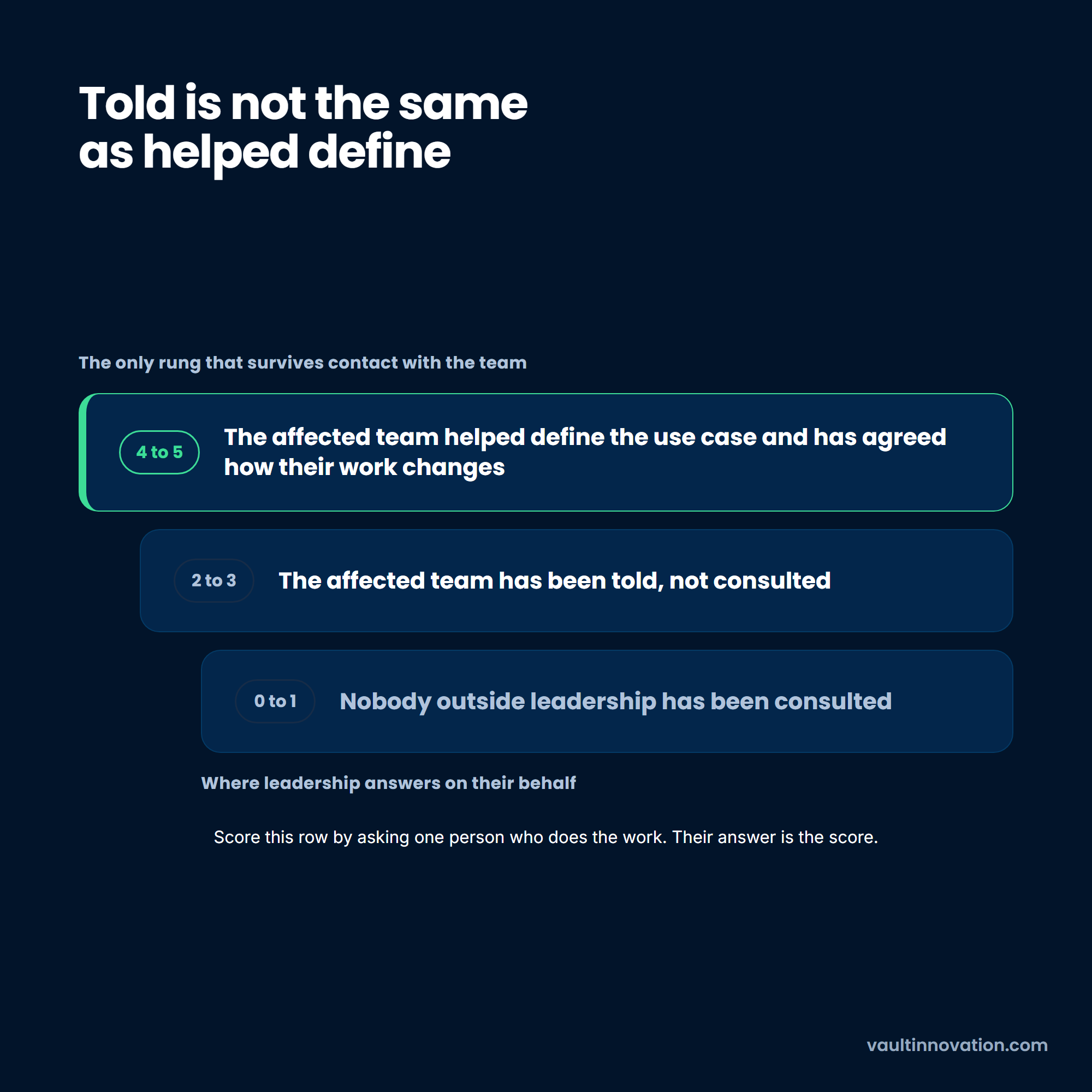
| People and adoption | Nobody outside leadership has been consulted | The affected team has been told, not consulted | The affected team helped define the use case and has agreed how their work changes |
| Measurement | No baseline for the process in question | The metric exists but nobody trusts it | A trusted baseline measured over at least a quarter |
Add the six numbers together. That total is what the rest of this article interprets. The measurement row is worth a second look before you move on, since a data-driven approach to any business question depends on the same trusted baseline.
Score bands are only useful if they change what you do next. These four do.
| Score | Reading | The right next move |
|---|---|---|
| 0 to 10 | Not ready. The blockers are structural | Fix data ownership and pick one process before spending anything on AI |
| 11 to 18 | Ready for a scoped pilot, not a platform | Run one use case end to end, with a real user and a real baseline |
| 19 to 24 | Ready to build for production | Commission the build, with governance and adoption planned in from the start |
| 25 to 30 | Ready to scale | Move from one use case to a portfolio, and invest in reusable data infrastructure |
The band that surprises people is the second one, because 11 to 18 is where most honest scorers land and it does not feel like a pass. It is one. A scoped pilot is the correct move for a company at that level, and attempting a platform instead is the single most expensive mistake in this whole area. Narrow scope is most of what makes the perfect project, on AI work and everything else.
Abstract scoring rubrics are easy to agree with and hard to apply, so here is one run through.
Take a 40-person distribution business that wants to use AI to handle inbound order emails. Data scores 2: orders live in an ERP, but the emails themselves sit in a shared mailbox nobody owns. Use case scores 4, because the process is specific, someone has counted the emails, and they know what an hour of order-entry time costs.
Technical foundation scores 3, since the ERP has an API but no staging environment. Governance scores 1, with no written policy and no named owner.
People and adoption scores 3: the two people doing order entry have been consulted and are cautiously in favor. Measurement scores 3, because they know roughly how many orders arrive but have never timed the process.
That totals 16. The right move is a pilot on one email type, not a platform, and the two dimensions to fix in parallel are governance and the shared mailbox. Both are cheap. Neither requires an AI vendor.
Laid out row by row, the shape of the score says more than the total.

A worksheet that hands back a number is only useful if the number means something outside its own logic, so it is worth stating plainly what these scores look like in the wild.
A 16 out of 30 sounds like a failing grade and is not one. In our experience the majority of small and mid-sized companies who score honestly land in the 11 to 18 band, which is why that band gets the most detailed advice above.
Scores above 24 are rare outside organizations that already run a data function. Scores below 10 are common in businesses whose core operations still run on spreadsheets, and that is a finding about record-keeping rather than about AI. It is also the point at which ordinary software does the most good, which is roughly the story of tech in small business over the past decade.
The calibration check that matters: if your score comes out above 24 and you have never run a data governance exercise, you have scored yourself optimistically. Go back to the data and governance rows and read the 0-to-1 column again. Those two are where generous self-assessment is most common, and where the correction is least painful before money is committed.
Of the six dimensions, data is the one that most often stops a project outright, and it is also the one companies most consistently underestimate.
The problem is rarely volume. It is that the useful data is spread across systems that were never designed to talk, in formats that disagree about what a customer record is. Consolidating it is unglamorous work with no demo at the end, which is exactly why it gets deferred until an AI project makes it unavoidable.
Only the top of that stack is something a vendor can sell you.

Nationwide Transfer is our clearest example of what that groundwork costs and returns. Twenty-eight million records had to be reshaped into one consistent form before anything could be built on top of them.
Not a line of that was AI. It is exactly the foundation that later decides whether an AI project takes six weeks or turns into an eighteen-month argument about which system is authoritative.
If your data row scored 0 to 1, that is your entire project for the next quarter. Everything downstream gets cheaper once it is done, including plenty of work that has nothing to do with AI.
Governance is the row people score lowest and worry about least, which is backwards. It is the row that stops a working pilot from ever reaching customers.
You do not have to invent a framework. NIST's AI Risk Management Framework organizes AI risk into four functions: GOVERN, MAP, MEASURE and MANAGE.
The framework also names seven characteristics of a trustworthy AI system, in NIST's own words: "valid and reliable, safe, secure and resilient, accountable and transparent, explainable and interpretable, privacy enhanced, and fair with their harmful biases managed."
For a company scoring itself, the useful move is to treat GOVERN as the row you just scored and the other three as what a project will need later. If you cannot name the person who would sign off on an AI feature reaching a customer, your governance score is a 1 regardless of what policies exist on paper.
Regulated industries feel this earliest. The way technology is reshaping insurance is a good illustration, since every automated decision there arrives with a documentation burden attached before it can go live.
Adoption is scored generously more often than any other dimension, because leadership tends to answer it on behalf of people who were never asked.
The test is specific. Has the team whose work changes actually helped define what the AI does? Not been informed, not been shown a demo, helped define it. If the answer is no, the honest score is 2 at most, however enthusiastic everyone sounds in the leadership meeting.
Only the top band describes a team that helped build the thing.
This connects directly back to the WEF finding about 39% of skill sets shifting. A tool that reshapes someone's day is a change management project wearing a technology costume, and the companies that treat it that way get their pilots into production. The ones that treat adoption as a rollout email do not.
Score this row by asking one person who does the work. Their answer is the score.
A low score is genuinely useful, because every item on it is something you would have needed regardless. Here is the sequence that closes the most ground fastest.
None of that requires an AI vendor, and most of it can be done by people you already employ. That is the point of scoring before buying, and it is the argument for treating readiness as product strategy rather than as procurement.
Where we get called in is the step after the score: building the data model, the integration or the AI feature once a company knows which one it actually needs. Scoring first is what turns that into a defined piece of work with a number attached, instead of an open-ended engagement nobody can price.
There is a growing market of AI readiness assessment tools, from consultancy-branded questionnaires to platform vendors' maturity scans. Some are genuinely useful, particularly the ones that connect to your systems and report what data actually exists rather than what you believe exists.
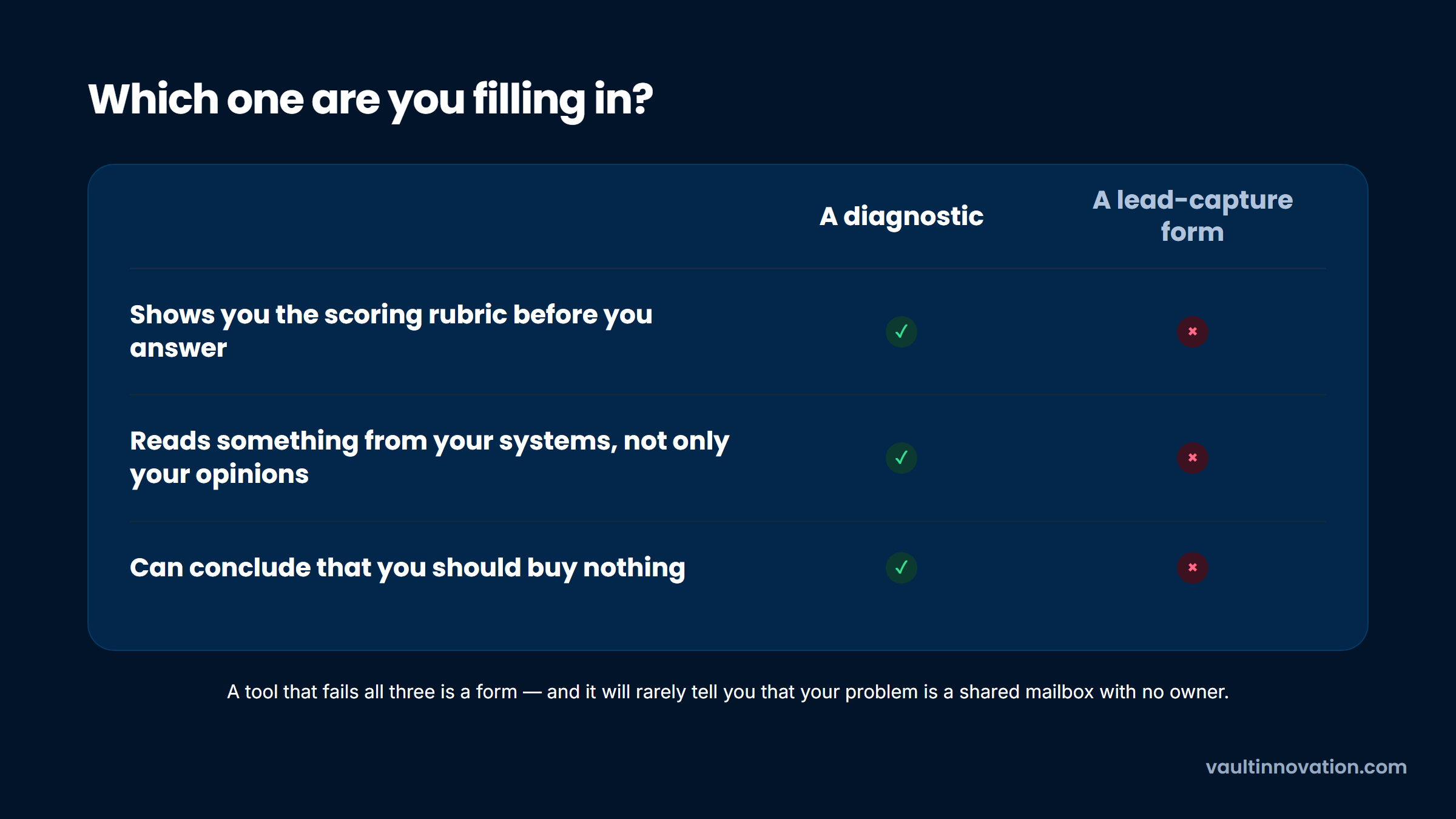
Most are not. A questionnaire that grades you against a rubric you cannot see, run by a company that sells the remedy, is a sales qualification instrument. It is not a diagnosis, and it will rarely tell you that your problem is a shared mailbox with no owner.
Three questions separate the useful from the promotional. Does the tool show you the scoring rubric before you answer? Does it read anything from your systems, or only your opinions? And does its output include a recommendation that involves not buying anything? A tool that fails all three is a form.
Scored against the same three questions, the two are easy to tell apart.
For most companies under a few hundred people, the six-row table above run honestly in a meeting will outperform any of them, because the constraint is candor rather than sophistication. Larger organizations running an enterprise AI readiness assessment across many business units genuinely need tooling, if only to keep dozens of scores comparable.
The number is not the deliverable. The value of scoring yourself is that it converts a vague anxiety about falling behind into four or five specific, ordinary pieces of work, most of which pay for themselves whether or not the AI project ever happens.
Run it, write the six numbers down, and put a date ninety days out to run it again. If the second score has not moved, the problem was never the technology.
If you want a second opinion on the score, particularly on the data and governance rows where self-assessment tends to be kindest, contact us. We would rather tell you that twelve weeks of unglamorous data work stands between you and a good project than sell you the project today.
It is a structured evaluation of whether an organization can get value from AI, run before committing to a specific project. It scores the conditions around the technology, usually data, use case clarity, technical foundations, governance, people and measurement, and produces a picture of which of those will block delivery. It is a diagnostic, not a technology selection exercise.
At minimum, a rubric you can see, dimensions that cover data and people rather than only technology, and score bands that map to different next actions. If a framework's every outcome leads to the same recommendation, it is a sales tool. The six-dimension worksheet in this article is deliberately small enough to run in a single meeting.
The dimensions are the same; the mechanics are not. A large organization is scoring many business units with different data estates and has to keep those scores comparable, which usually means tooling and a consistent scoring panel rather than a spreadsheet. It also has to add procurement, vendor risk and often works council or regulatory review, none of which apply to a 40-person company.
The self-assessment in this article takes about ten minutes, and its accuracy depends on whether you ask the people who do the work rather than answering on their behalf. A formal assessment with data profiling and stakeholder interviews typically runs two to four weeks. The difference in cost is large; the difference in what they conclude is often small.
Anything from 19 upward supports a production build. From 11 to 18, run one scoped pilot with a real baseline rather than commissioning a platform. Below 11, the useful work is fixing data ownership and picking a single measurable process, and that work will pay off whether or not you ever deploy a model.
Ten minutes and six honest numbers will tell you more about your odds with AI than any vendor demo will, and nothing stops you running the worksheet again in a quarter to see whether anything moved.
If the result points at work you would rather not take on in-house, contact us. We will tell you which rows genuinely need an outside team and which ones you can close on your own.


